Renting a car in Iceland: the Ring Road, gravel damage and F-roads
Some buttons on this page link to vrooem.com, where you compare and book the offer of international rental companies. Our guides are written independently.
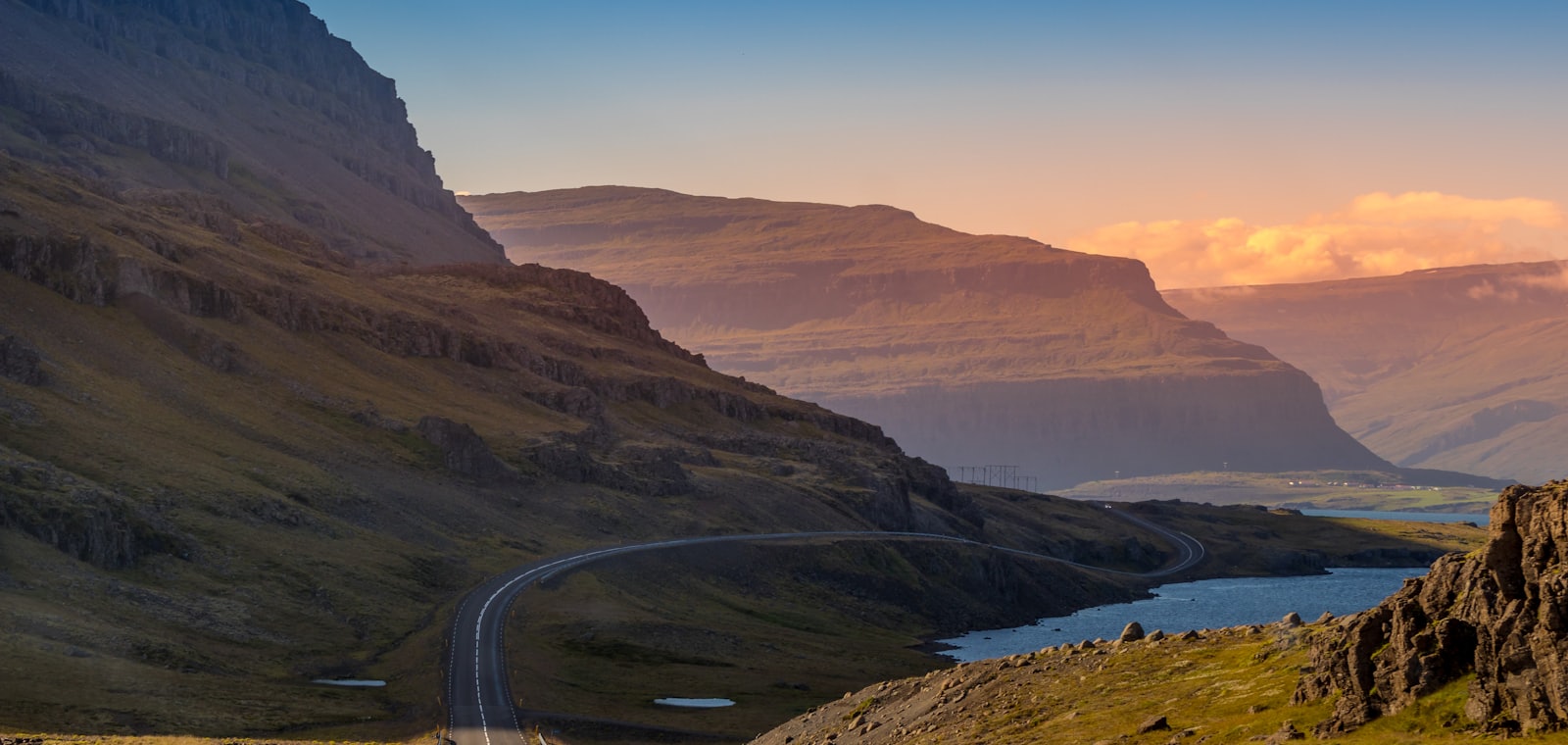
Iceland is built for the car. The whole island hangs from a single ribbon of asphalt, the Hringvegur or Ring Road, which loops in a great circle of some 1,300 kilometres past nearly everything you want to see: glaciers, waterfalls, black beaches, steaming geysers and lava fields stretching to the horizon. Step into a rental car and you step into the only way to experience all of it at your own pace.
Because public transport outside the capital Reykjavík amounts to very little. There are buses between the larger towns, but the most beautiful spots lie at the end of a gravel road where no bus goes. With a car you drive past a deserted fjord in the morning, stop wherever you like for a herd of Icelandic horses, and stand at a waterfall in the evening without another soul in sight. That freedom is exactly why most travelers rent a car here.
But Iceland is also rugged, and the nature that is so impressive eats away at your rental car. Wind that wrenches doors out of your hands, gravel that smacks against the paintwork, sandstorms, rivers you have to ford on the highland roads. This is not a country where you blindly book the cheapest deal and set off. Those who understand the risks enjoy it with a clear mind. Those who ignore them sometimes get a bill on return that throws the whole travel budget into disarray. This guide steers you through it.
Do I really need a car in Iceland?
Yes, for almost everyone. Unless you stick to Reykjavík and a few organised day trips, your own car is the only practical way to see the country. The distances are great, the sights lie far apart, and the spontaneity of stopping whenever you want is priceless in Iceland.
Almost everyone starts at Keflavík airport (KEF), about a 45-minute drive from Reykjavík. The rental desks are partly in the terminal and partly a few minutes away by shuttle. Always reserve in advance, especially in high season (June to August), because the fleet is limited and on the day itself there is little choice left.
The big choice is 2WD versus 4x4. That is not a question of luxury but literally determines where you may and can drive.
| 2WD (ordinary passenger car) | 4x4 / SUV | |
|---|---|---|
| Ring Road in summer | Fine | Fine |
| Golden Circle, south coast | Fine | Fine |
| F-roads (highlands) | Forbidden | Required |
| River crossings | Never | Possible, never insured |
| Winter / snow | Limited, risky | Strongly recommended |
| Fuel use | Lower | Higher |
For a summer Ring Road tour without highlands, a solid 2WD is enough. If you want to take on the F-roads, or you travel in winter, a 4x4 is not a needless luxury but simply a necessity.
Which insurance is genuinely different in Iceland?
Iceland has insurance policies you encounter nowhere else in Europe, because the nature there causes damage that does not exist elsewhere. The standard CDW (Collision Damage Waiver) covers collisions and rollovers, but specifically leaves out the typically Icelandic risks. That is why rental companies offer separate, extra coverages.
The three you need to know are Gravel Protection, Sand and Ash Protection, and the matter of wind damage. Pay close attention to the difference between what the basic coverage does and does not do.
| Coverage | What it (usually) covers | Important limitation |
|---|---|---|
| CDW (standard) | Collision, rollover, part of the bodywork | Excess remains, gravel/sand/wind often excluded |
| Gravel Protection (GP) | Stone chips from gravel against paint, headlights, windscreen, underbody | Does not apply for off-road or F-road violations |
| Sand and Ash Protection (SAAP) | Paint damage from sandstorm and volcanic ash | Often high excess, not available everywhere |
| Theft Protection | Theft | Small risk in Iceland, sometimes already included |
Gravel Protection (GP) is almost indispensable in Iceland. As soon as the asphalt turns to gravel, and that happens more often than you think, the wheels of oncoming cars throw up little stones that ricochet against your paint, headlights and windscreen like bullets. A windscreen cracked by a stone chip is a classic. Without GP you pay for that yourself.
Sand and Ash Protection (SAAP) covers something more specific: in parts of the south, especially around the black sand plains near Vík and the Skeiðarársandur, the wind can blow so hard that driven sand or volcanic ash strips the paint away completely in minutes. That sounds extreme, but it happens. If you travel along the south coast, give SAAP serious thought.
And then the wind, the most notorious risk of all. Iceland is known for sudden, extreme gusts. The scenario rental companies see most often: you open your door in a car park, the wind grabs the door, wrenches it fully open and bends or breaks the hinge. Wind damage to doors is almost never covered by any insurance whatsoever. The only protection is behaviour: always hold your door firmly with both hands when opening and closing, and park with your car nose or tail into the wind, not side-on.
It pays to understand thoroughly in advance how deposit and excess work here, because the amounts can be high. For that, read our explanation of excess and deposit. And weigh up whether an all-inclusive or the cheapest rental car is wisest for you here; in Iceland that trade-off tips towards all-in more often than in most countries.
What are F-roads and may I just drive there?
F-roads are the highland roads, and no, you may not just drive there. The F (from fjall, mountain) marks unpaved routes that lead into the rugged interior, to places like Landmannalaugar and Þórsmörk. They are forbidden by law for 2WD vehicles and require a genuine 4x4. A normal SUV without four-wheel drive does not count.
These roads are open only in summer, roughly from late June to early September, depending on snow and weather. The rest of the year they are closed. On road.is and safetravel.is you can see the current status; always check it before you set off, because opening dates shift from year to year.
The biggest insurance hazard on F-roads is the fords. Many F-roads cross rivers without a bridge, and you have to drive literally through them. Damage from water fording, a stalled or drowned engine, is never insured in Iceland, by any coverage. Do not underestimate this: river levels change by the hour with meltwater, and what is shallow in the morning can sweep your car away in the afternoon. If you do not get out first to judge the depth and current, or you have doubts, turn back.
How do you drive safely on Icelandic roads?
The general level of caution is higher in Iceland than at home, because of a handful of peculiarities you rarely meet elsewhere. They are not difficult, but you have to know them.
Single-lane bridges (einbreið brú) are everywhere on the Ring Road. One lane for both directions: whoever gets there first has priority, the other waits before the bridge. Always approach them slowly and look carefully.
Blind hills (blindhæð) are narrow roads where you drive over a rise without seeing what comes behind it. Keep right and slow down, especially on gravel roads.
The transition from asphalt to gravel is a notorious moment. The car can break loose if you drive too fast; ease off the speed before you go onto the gravel. And on gravel: keep your distance and watch for oncoming traffic, because that is where the stone chips come from.
Sheep roam freely and cross unpredictably, often in small groups with a lamb on the other side of the road. Brake, do not honk, and count on the second sheep still having to make the crossing.
Off-road driving is strictly forbidden and heavily fined in Iceland. The fragile moss vegetation barely recovers. Always stay on the marked road or the laid-out path, even for a good photo.
What about refuelling in Iceland?
Most pumps are unmanned, so you fill up with your card at the machine. Between the larger towns there are sometimes long stretches without a pump, so the rule of thumb is simple: top up when you drop below half, certainly before you head into the interior or onto a quiet stretch of Ring Road.
The crucial detail is your payment card. Many unmanned pumps, especially N1, Olís and Orkan, ask for a PIN in advance and sometimes reserve an amount on your card. A card without a PIN, or a card that only works contactless, can be refused at those machines. So make sure you carry a credit card or debit card whose PIN you know. Some stations work with prepaid credit cards you buy inside; handy as a backup.
Winter or summer: what is the difference behind the wheel?
The season changes your whole driving experience. Summer means long days, open highlands and relatively easy driving; winter means short days, ice and roads that can close at any moment.
In summer (June to August) you have the midnight sun: it barely gets dark, so you can drive on endlessly and stop whenever you like. The F-roads are open, the weather is milder, and the Ring Road is in principle quite manageable with a 2WD. This is the most comfortable season for a first trip to Iceland.
In winter (roughly November to March) everything is about safety. The days are extremely short, sometimes with only four to five hours of light, so you drive a lot in the dark. Roads can be icy, snow-covered or temporarily closed, and the weather turns quickly. Winter tyres are then mandatory and almost always already fitted on the rental car; check that. A 4x4 is strongly recommended. Check road.is every morning for road status and vedur.is for the weather, and adjust your plans rather than stubbornly driving on.
Route suggestion 1: Golden Circle and south coast
This is the classic introduction, ideal for anyone with three to four days who wants to see the highlights of the south-west. Easily driven with a 2WD in summer. The times below are rough estimates; reckon on more stops than you think.
| Day | Route | What you see |
|---|---|---|
| 1 | Reykjavík, Golden Circle | Þingvellir, Geysir, Gullfoss |
| 2 | South coast west | Seljalandsfoss, Skógafoss, Sólheimasandur |
| 3 | South coast to Vík | Reynisfjara (black beach), Dyrhólaey, Vík |
| 4 | Back, optional detour | Kerið crater, Hveragerði, Reykjavík |
On day 1 you do the Golden Circle: Þingvellir National Park where two tectonic plates drift apart, the geyser area around Geysir with the active Strokkur, and the mighty Gullfoss waterfall. Reckon on roughly a full day with the drive there and back.
Days 2 and 3 follow the south coast eastwards. You can walk behind Seljalandsfoss, Skógafoss thunders down some sixty metres, and at Vík you find the black lava beach Reynisfjara with its basalt columns. Watch out there for the sneaker waves, which are lethal; stay well away from the waterline. It is right here, around Vík and the sand plains, that the wind risk is greatest.
Route suggestion 2: the full Ring Road
Anyone with seven to ten days can drive the whole Ring Road. This is the grand tour, and ten days is more comfortable than seven. Quite manageable with a 2WD in summer; preferably drive in one direction so you do not repeat anything.
| Day | Stage (indicative) | Highlights |
|---|---|---|
| 1 to 2 | Reykjavík, south coast, Vík | Waterfalls, black beach |
| 3 | Vík to Skaftafell, Jökulsárlón | Glacier lagoon, icebergs |
| 4 to 5 | Eastfjords | Quiet fjords, fishing villages |
| 6 | Egilsstaðir, Mývatn | Volcanic area, Dettifoss |
| 7 | Mývatn, Akureyri | Goðafoss, northern capital |
| 8 to 9 | North-west, Snæfellsnes | Peninsula, Kirkjufell |
| 10 | Back to Reykjavík | Wrapping up |
The biggest mistake on the Ring Road is planning too many kilometres per day. The distances look small on the map, but with the constant stops, the wind and the narrow roads you make slower progress than expected. Three to four hours of net driving per day is comfortable; more becomes tiring and takes the joy out of it. Book your overnight stays in advance in high season, because the small villages have few beds.
Roughly what does a rental car in Iceland cost?
We deliberately do not name amounts here: the price depends on your dates, the season, the vehicle class, the coverage you choose and how early you book. You see the current price for your trip when you search on Vrooem. What mainly determines your total bill:
- Vehicle class. A 2WD or a 4x4. If you want to take on the F-roads, a 4x4 is required.
- Coverage. The standard CDW and the extra Icelandic coverages you add, such as Gravel Protection and Sand and Ash Protection.
- Fuel. The distances are great, so include refuelling in your travel budget.
Book early, certainly for the summer, because the fleet is limited.
Also count on a deposit being blocked on your credit card. Make sure your credit limit can handle that. You can read more about this in excess and deposit and in our guide on which documents you need.
Which mistakes do travelers make most often?
The most expensive blunders in Iceland are nearly all avoidable. A few stand out time and again:
- Letting a door blow open in the wind. The classic, and almost never covered. Always hold the door.
- Skipping Gravel Protection. A windscreen cracked by a stone chip is a classic, and without GP you pay for that yourself.
- Driving onto an F-road with a 2WD. Forbidden, and your insurance lapses on the spot.
- Fording a river without thinking. Never insured, and lethal in high water.
- Planning too many kilometres per day on the Ring Road. You underestimate the time stops and wind take.
- Refuelling with a card without a PIN. At an unmanned pump you are then stuck.
- Not photographing the car at pick-up. Record existing scratches and stone chips, so you do not pay for a predecessor’s damage.
If you want to set off more broadly prepared, also read our 12 tips for renting a car abroad.
Frequently asked questions
Do I need a 4x4 in Iceland?
Not always. For the Ring Road, the Golden Circle and the south coast in summer, a solid 2WD is enough. A 4x4 is required on the F-roads (highlands), however, and strongly recommended in winter because of snow and ice.
What is Gravel Protection and do I need it?
Gravel Protection (GP) covers stone-chip damage from flying gravel to paint, headlights and windscreen. In Iceland you often drive on or alongside gravel roads, so this coverage is almost indispensable. Without GP you pay in full for a cracked windscreen or damaged paint yourself.
Is wind damage to a rental car insured?
Usually not. Damage from the wind wrenching a door open and bending or breaking the hinge falls outside virtually all insurance. The only protection is always holding your door firmly when opening and closing, and parking with the nose or tail into the wind.
May I drive over the F-roads with an ordinary car?
No. F-roads are forbidden by law for 2WD vehicles and require a genuine 4x4. Drive there with a 2WD anyway and your insurance lapses entirely. Moreover, the fords on F-roads are never insured, not even with a 4x4.
When are the F-roads open?
Only in summer, roughly from late June to early September, depending on snow and weather conditions. The exact opening dates differ by year and by road. Always check the current status on road.is and safetravel.is before you set off.
Can I refuel anywhere in Iceland with my bank card?
Usually yes, but many unmanned pumps ask for a PIN in advance. A card without a working PIN or only with contactless payment can be refused. Make sure you carry a credit card or debit card whose PIN you know.
How many days do I need for the Ring Road?
Reckon on seven to ten days for a relaxed tour, with ten being more comfortable than seven. The distances look small on the map, but stops, wind and narrow roads take more time than you think. Three to four hours of net driving per day is a pleasant pace.
Is it safe to drive in Iceland in winter?
It can be, but it demands preparation and caution. The days are short, roads can be icy or closed, and the weather turns quickly. Winter tyres are mandatory, a 4x4 is strongly recommended, and you check road.is and vedur.is every morning for road and weather status.
Ready to compare?
Compare the prices of international rental companies in a few taps and book with peace of mind.
See the offer on Vrooem