Renting a car in Switzerland: the vignette, alpine passes and the most beautiful routes
Some buttons on this page link to vrooem.com, where you compare and book the offer of international rental companies. Our guides are written independently.
Why Switzerland by car is something different
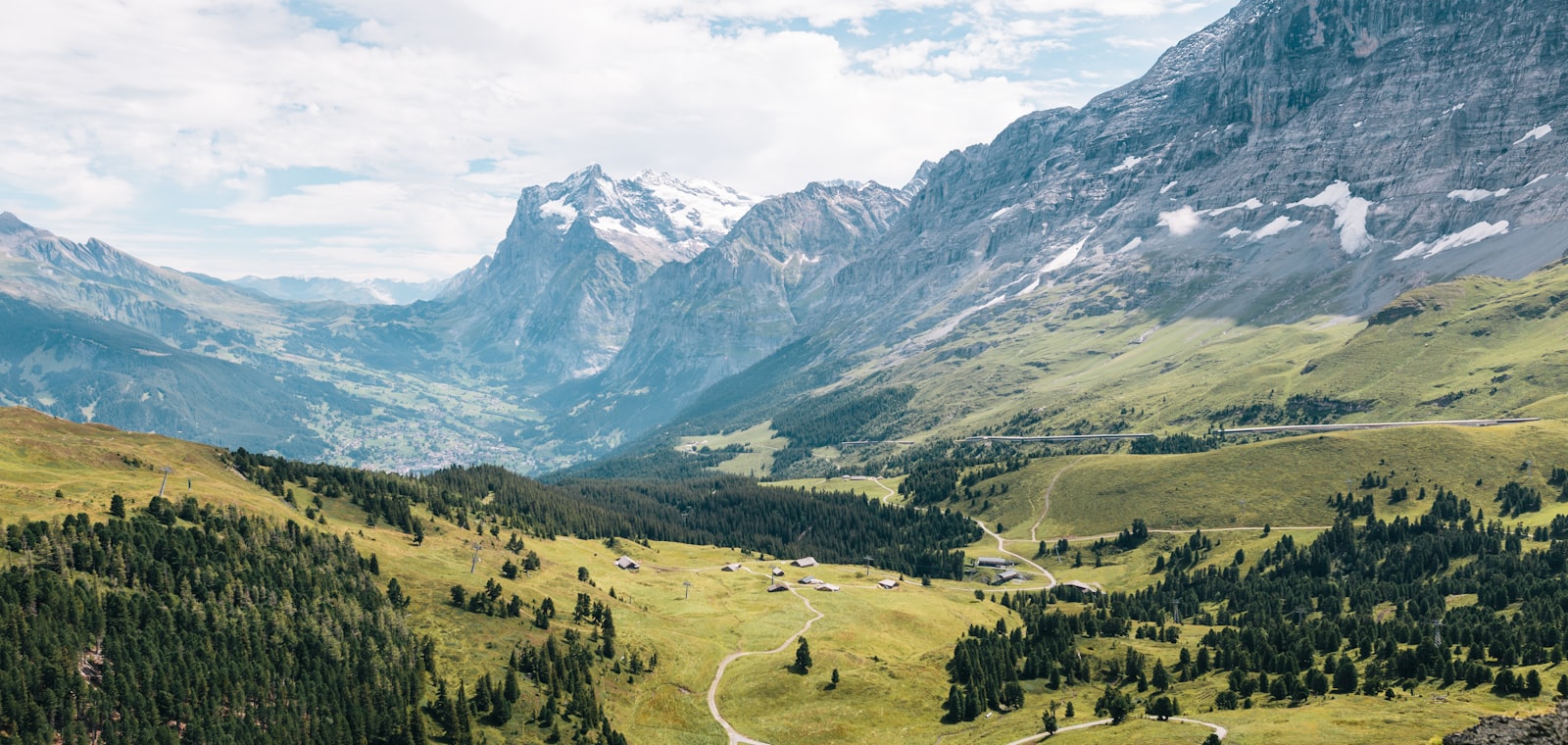
Some countries you visit, and some countries you drive. Switzerland belongs unmistakably to that second category. Picture this: in the morning you leave a village beside a lake so still that the mountains seem to drown in it, you climb a series of hairpin bends up to where the air grows thinner and the last patches of snow still cling to the roadside in June, and by midday you descend into a green valley where cows with bells around their necks are the only traffic. All of that in a single day, just a few hours of driving. No other country in Europe packs so much landscape into so few kilometres.
The charm lies precisely in that compactness. Whereas in France or Scandinavia you can drive for hours along a motorway before the scenery really changes, in Switzerland the backdrop shifts every ten minutes. One moment you are driving through Italian-feeling palm-tree villages on Lake Maggiore, the next through a stern German-speaking mountain valley dotted with wooden chalets. Three cultural regions, four national languages and an endless stacking of mountains, glaciers and lakes, all within a country smaller than roughly half of France.
And yet driving here is not a given for the visiting traveller. Switzerland’s public transport is world-famous and excellent, the roads are expensive, and mountain driving asks a little more attention than a trip across flat countryside. This guide walks you through everything you need to know before you set off: the compulsory vignette, the legendary alpine passes, the winter rules, the most beautiful routes and the costs you would do well to prepare for. So that the road becomes a pleasure and not a surprise.
Rental car or train: when is each worth it?
Let’s be honest: the Swiss train is not a fallback but a sight in itself. Trains run to the minute, reach the highest valleys, and panoramic routes such as the Glacier Express or the Bernina Express are experiences no rental car can match. For anyone travelling from city to city (Zurich, Lucerne, Interlaken, Geneva) the train is often faster, cheaper and less stressful than a car with all the parking misery that comes with it.
But the moment you stray from the main axes, the picture tilts. A rental car wins when you want to:
- explore the remote alpine valleys and mountain passes that are awkward or slow to reach by train
- travel with the family or with a lot of luggage (child seats, skis, hiking gear)
- set your own pace and stop spontaneously at every viewpoint
- combine several regions on a round trip, away from the busy stations
The train, on the other hand, wins for pure city breaks, for the great panoramic routes, and when you have no appetite for city-centre parking fees that exceed the price of a lunch. Many travellers therefore opt for a hybrid approach: train for the cities, rental car for a few days in the mountains.
Airports, regions and the language of the road signs
The three large international airports are logical starting points, each with its own language region and its own approach route towards the mountains. You can fly in quickly, but plenty of travellers simply drive on to just over the border and rent there, or take their own car. Anyone renting locally usually sets off from one of these three.
| Airport | Region and language | Ideal starting point for |
|---|---|---|
| Zurich (ZRH) | German-speaking, northeast | Central Switzerland, Graubünden, the alpine passes around Andermatt |
| Geneva (GVA) | French-speaking, southwest | Valais, Montreux, Lake Geneva, the route towards Zermatt |
| Basel (BSL) | German-speaking, northwest (tri-border point) | Jura, the gateway to the Bernese Oberland and the northwestern Grand Tour |
You feel the multilingualism above all on the signs. In the north and east everything is German (Ausfahrt = exit, Umleitung = diversion), in the west French (sortie, déviation), and in Ticino in the south Italian (uscita, deviazione). Place names change along with the language: Geneva is Genf in German, Basel is Bâle in French. Good navigation handles this for you, but it helps to know that the same little town can carry two names.
The vignette: Swiss motorway toll in a single sticker
This is the most important practical point for anyone using the Swiss motorways. Switzerland has no per-trip toll gates like France, but a single compulsory annual vignette that grants access to the entire motorway and dual-carriageway network. Driving onto the motorway without a valid vignette earns you a hefty fine, on top of the price of the vignette itself.
There is no day or week vignette: it is always an annual one, valid from the start of December until the end of January of the following year (fourteen months in practice). For some time now, alongside the classic sticker on the windscreen, there has also been an e-vignette linked digitally to the number plate. Both are equally valid; checks are partly automatic via cameras.
The vignette covers the regular motorway network, but not everything. A handful of major alpine tunnels and car-trains charge a separate fee, independent of the vignette:
| Crossing | Type | Practical |
|---|---|---|
| Great St Bernard Tunnel | Toll tunnel | Separate payment, connection towards Italy (Aosta) |
| Lötschberg car-train (Kandersteg–Goppenstein) | Car-train | Your car on the train through the mountain, saves a long detour |
| Furka car-train (Realp–Oberwald) | Car-train | Handy when the Furka Pass is closed or the weather is bad |
| Vereina car-train (Klosters–Sagliains) | Car-train | Connection to the Engadine, all year round |
These car-trains are not an emergency measure but often a fine experience in themselves: you drive your car onto an open wagon, stay seated inside, and roll through the mountain as it goes dark outside. For the Vereina and the Lötschberg you pay per car, on the spot or in advance.
Alpine passes and mountain driving: the art of the hairpin bend
This is where the real adventure begins. The Swiss mountain passes are the reason many people rent a car in the first place: narrow ribbons of asphalt that fold their way up the mountainside in dozens of hairpin bends, with a fresh view at every turn. It is spectacular, but it calls for a driving style you rarely use on flat roads.
The basic rules of mountain driving
A few principles make the difference between enjoying and sweating:
- Brake with the engine, not with the brakes. On a long descent, shift down to a low gear and let the engine do the braking. If you keep riding the brakes, they overheat and you lose braking power precisely where you need it.
- Vehicles driving uphill generally have priority. On narrow mountain roads it is harder for the climbing car to stop and pull away again, so it is given priority. Find a passing place (often signposted) and let it through.
- Postal buses are the boss. The yellow postal coaches have absolute priority on narrow mountain routes and announce themselves with a three-tone horn. If you hear it, make room.
- Account for the altitude. At high altitude the engine performs a little less well and you yourself may feel slightly light-headed. Take it easy, drink water, and allow yourself stops.
Which passes are open when
This is crucial for your planning. The high passes are seasonal: they generally open only in late spring and close again in autumn as soon as the snow arrives. Count on a reliable open season somewhere from June to October, but that shifts from year to year and from pass to pass. Always check the current status just before you leave, because an early snowfall can close a pass from one day to the next.
| Pass | Height (approx.) | Generally open | Character |
|---|---|---|---|
| Furka Pass | over 2400 m | summer to autumn | Famous from film, bare high plateau, view of the Rhône Glacier |
| Grimsel Pass | over 2100 m | summer to autumn | Reservoirs and bare granite landscape |
| Susten Pass | over 2200 m | summer to autumn | Flowing curves, greener, technically enjoyable |
| St Gotthard Pass | over 2100 m | summer to autumn | Historic cobbled road (Tremola) alongside the modern route |
| Klausen Pass | over 1900 m | summer to autumn | Quieter, beautiful valleys |
In winter most of the high passes are simply closed. You then cross the mountains via tunnels (such as the Gotthard Tunnel) or via the car-trains. So plan your trip around the season: an alpine-pass loop only makes sense in summer.
Winter: tyres, chains and skiing
Switzerland has no general, calendar-based winter-tyre requirement like some neighbouring countries, but a situational rule: your vehicle must be adapted to the conditions. In practice that means winter tyres as soon as there could be snow, ice or mud, and in the mountains that is the case soon enough. If you cause a tailback or an accident with summer tyres on a snowy road, you are liable and risk a fine.
If you rent during the winter season, the rental company usually supplies the car with winter tyres. Confirm this explicitly when you book, especially if you are heading to a ski resort.
If you drive to a ski destination such as Zermatt, Verbier or Davos, bear in mind that some high-altitude villages are car-free. Zermatt, for example, cannot be reached by car: you park in Täsch and take the train for the last stretch. Check this per destination before you set off.
Three routes to dream about
Enough theory. Here are three concrete routes that show why you rent a car for this. The time estimates are generous: in the mountains you drive more slowly than the map suggests, and you will want to stop anyway.
Route 1: the great alpine-pass loop (Furka, Grimsel, Susten)
This is the classic among driving routes, a loop you can start from Andermatt or the Bernese Oberland. You string three spectacular passes together into a day full of hairpin bends and views you will not soon forget.
Set off, for instance, towards the Furka Pass, where you can stop at the Rhône Glacier (the pass where the famous car chase from an old James Bond film was shot). Descend to Gletsch and immediately climb again to the Grimsel Pass, past deep-blue reservoirs in a bare granite landscape. Close the loop via the greener, flowing Susten Pass back towards your starting point. Count on a full day: pure driving is perhaps three to four hours, but with stops, photos and a lunch along the way you are easily occupied for eight to ten hours. And that is exactly the idea.
Route 2: a stretch of the Grand Tour of Switzerland
The Grand Tour is an official, signposted circuit of more than 1600 kilometres that strings together almost all the country’s highlights. You don’t have to do it all; a fine partial leg is already worthwhile. A popular stretch runs from Lake Lucerne via the St Gotthard to sunny, Italian-feeling Ticino with Lugano and Lake Maggiore.
Along the way you switch from the stern German-speaking mountain world to palm trees and piazzas within a single drive, one of the most astonishing cultural shifts you can make by car in Europe. To savour the atmosphere to the fullest, drive the old cobbled road (the Tremola) over the Gotthard instead of the tunnel. For this partial leg with stops, count on one to two days, depending on how long you linger in Ticino. And you will linger.
Route 3: Bernese Oberland and Graubünden
For those who would rather explore valleys and lakes than pure passes. In the Bernese Oberland you drive around Interlaken between Lake Thun and Lake Brienz, with the iconic Eiger, Mönch and Jungfrau as a backdrop. Combine a day of driving through the valleys with a train ride or cable car to the heights (many summits cannot be reached by car, and that is fine).
Head east to Graubünden and you arrive in a quieter, more rugged Switzerland: the Engadine with its luminous valleys, the world-famous bend near Tiefencastel, and fashionable places such as St Moritz. Here the Vereina car-train is your friend for rolling quickly into the Engadine without a high pass. For a good taste of both regions, count on three to four days of driving around, generously measured.
Driving electric through the mountains
Switzerland is excellently equipped for electric cars. The fast-charging network along the main axes is dense and reliable, and in tourist areas you will find charging points readily too. If you rent an EV, there are a few points to watch that relate specifically to the mountains.
Climbing costs a lot of energy, so your consumption shoots up on a long ascent and your range drops faster than you are used to. The good news: on the way down you recover a good part of it through regeneration, with engine braking topping the battery back up. Plan your charging stops with some margin and charge up in good time, because in remote high valleys the chargers are spaced further apart. To be safe, take a charging card or app that is widely accepted, and ask at pick-up which charging cable is included.
What it costs: count on an expensive country
No illusions: Switzerland is one of the most expensive countries in Europe, and you feel that behind the wheel too. We deliberately name no fixed amounts, because rates fluctuate sharply by season, rental company and moment of booking, but here is what to reckon with.
- The rental itself is generally higher than in neighbouring countries, especially in high season and during the ski holidays. Booking early pays off.
- Fuel is pricey there. Preferably fill up before you enter the country if you are coming from a neighbouring country.
- Parking in cities and at tourist attractions can mount up considerably; in centres expect steep hourly rates.
- The vignette is a one-off annual cost, but factor it in if you are coming in your own car.
- Car-trains and toll tunnels cost extra per crossing, separate from the vignette.
Add to that the generally high price of food and accommodation, and you understand why good budget planning here is no needless luxury.
Parking and refuelling in practice
Parking in Switzerland works largely through a colour-code system. Blue zones are free but time-limited: you place a parking disc behind the windscreen and may stay for a limited time (often around an hour, sometimes longer). White zones are paid, usually via a machine or app. Red zones are rare and allow longer times. Ask whether your rental car has a parking disc in the glovebox; if not, buy one (available at petrol stations and kiosks).
In city centres and at busy destinations you are often better off with a car park (P with a roof symbol): more expensive per hour but without the hassle and without the fine risk. Refuelling works as it does everywhere: many stations take a card at the pump, and in tourist areas they are plentiful. Bear in mind that some staffed stations close in the evening, leaving you reliant on machines with card payment.
Insurance and deposit: extra important in the mountains
Mountain driving increases the risk of minor damage, and that is where insurance plays a leading role. On narrow passes with rock faces on one side and a drop on the other, plus gravel and falling stones on the road surface, you pick up a scratch, a stone chip in the windscreen or wheel-rim damage more quickly than on a flat motorway. It is precisely these small damages that often fall within your excess.
The standard CDW cover (Collision Damage Waiver) on a rental car almost always comes with a high excess and a hefty deposit blocked on your card. In the event of damage that amount can be withheld in full until the matter is settled. For a mountain driving holiday it is therefore doubly worthwhile to buy off your excess, either through the rental company or via a separate, often much cheaper external insurance that you arrange in advance. Read carefully beforehand what is and isn’t covered: tyres, windscreen, underbody and roof sometimes fall outside the standard cover, and those are exactly the parts most vulnerable in the mountains.
Look into this before you leave; we explain it fully in our guide on excess and deposit. And also check how cross-border driving works: if you want to push on from Switzerland into Austria or make a loop by car to France, report that to the rental company, because not every rental allows trips to every country.
Common mistakes
A few pitfalls keep cropping up. Avoid them and your trip will run a good deal more smoothly.
- Joining the motorway without a vignette in your own or a foreign car. Arrange it before the border.
- Planning a high pass outside the season. In May or October your dream route may simply be closed. Always check the current status.
- Not buying off the excess for a mountain holiday, then getting a fright at the deposit being blocked or the bill after a scratch.
- Heading into the mountains with summer tyres in the shoulder season. Confirm winter tyres at booking if snow is possible.
- Planning too tightly. Mountain kilometres take longer than flat ones. Allow plenty, or you will be rushing through the most beautiful part.
- Driving to a car-free village such as Zermatt without knowing you have to park in Täsch.
You will find more general wisdom for anyone renting a car abroad in our 12 tips.
Frequently asked questions
Is the vignette already on a Swiss rental car?
Usually yes. A rental car delivered in Switzerland mostly already has the annual vignette on the windscreen or registered digitally on the number plate. Even so, always check this explicitly at pick-up. If you arrive in your own car or a foreign rental car, you must arrange the vignette yourself before you join the first motorway.
Do I need a rental car or is the train better?
That depends on your trip. For city breaks and the great panoramic routes the Swiss train is often faster and less stressful. For remote mountain valleys, mountain passes and travel with a lot of luggage or a family, the rental car wins. Many travellers combine the two: train for the cities, car for a few days in the mountains.
When are the alpine passes open?
The high passes are seasonal and generally open from roughly June to October, but that shifts from year to year and from pass to pass. An early or late snowfall can close a pass suddenly. Always check the current status just before you leave and plan a pass route in summer.
Are winter tyres compulsory?
Switzerland has no fixed calendar requirement, but a situational rule: your car must be adapted to the conditions, which in practice means winter tyres as soon as there is snow or ice. If you drive on summer tyres and cause problems, you are liable. Confirm winter tyres with your rental company if you are driving in the winter season or into the mountains.
Is driving in Switzerland expensive?
Count on an expensive country. The rental, the fuel and the parking are generally higher than in neighbouring countries, and on top of that come the vignette and any car-trains or toll tunnels. Booking early and filling up before the border help to keep costs down.
Should I be afraid of the hairpin bends?
Not afraid, but alert. Brake with the engine rather than the brakes on long descents, give priority to climbing traffic and postal buses on narrow stretches, and take your time. Anyone who drives calmly and stops regularly experiences the passes as the highlight of the trip rather than as an ordeal.
Can I take an electric rental car into the mountains?
Yes, Switzerland has a dense and reliable charging network. Bear in mind that climbing costs a lot of energy and your range drops faster, although you recover part of it on the way down through regeneration. Plan charging stops with margin, especially in remote high valleys, and ask at pick-up about the charging cable and a widely accepted charging card.
May I drive my Swiss rental car abroad?
Often yes, but not always and not to every country without question. If you want to push on into Austria, Italy or France, report that to the rental company in advance and check whether a surcharge or restriction applies. An unreported border crossing can jeopardise your cover.
Ready to compare?
Compare the prices of international rental companies in a few taps and book with peace of mind.
See the offer on Vrooem