Renting a car in Ireland: driving on the left, narrow roads and the insurance trap
Some buttons on this page link to vrooem.com, where you compare and book the offer of international rental companies. Our guides are written independently.
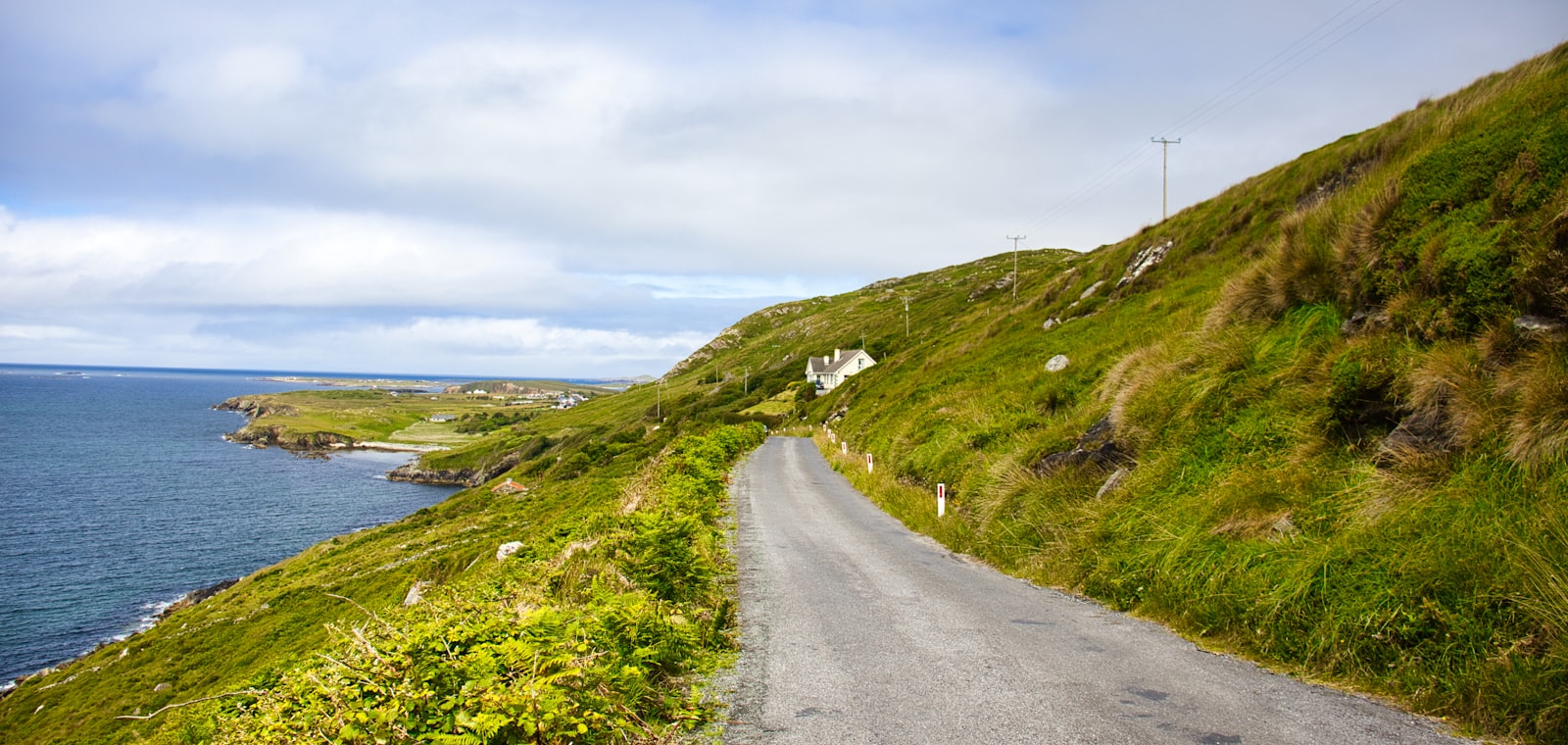
Picture this: a narrow road winding along a clifftop, the Atlantic Ocean breaking on black rocks down to your left, and green hills rising into the clouds on your right. No billboards, no traffic jams, just sheep grazing the verge and the occasional whitewashed village with a pub where the turf is still smouldering. This is the Wild Atlantic Way, the coastal route that stretches for more than two thousand kilometres along the west coast of Ireland. And the only way to truly experience it is from behind the wheel.
Ireland is a country that doesn’t fit neatly into a train timetable. The most beautiful spots are precisely where no train goes: at the end of a dead-end boreen, on a peninsula jutting into the sea, in a valley where the morning mist still hangs in the hills. With a rental car you decide for yourself when to stop for a photo, a walk or a cup of tea with soda bread.
But driving in Ireland takes preparation. You drive on the left, the roads are often narrower than you’re used to, and a costly surprise lurks in the insurance that many visitors only discover at the airport counter. This guide walks you through it calmly, so you can set off relaxed.
Why rent a car in Ireland?
Because public transport won’t take you to where Ireland is at its most beautiful. The trains mainly connect the larger cities, and bus routes to remote coasts sometimes run only a few times a day. With a car you open up the entire island.
The appeal lies in the loop routes and peninsulas. The Ring of Kerry, the Dingle Peninsula, the Cliffs of Moher, Connemara: these are circular drives and coastal roads you’ll want to take at your own pace, with the freedom to stop at every view. Many of the loveliest B&Bs and small restaurants are also tucked away in villages you can barely reach without a car.
For a city break to Dublin alone you don’t need a car; there a vehicle is more of a burden because of parking pressure and tolls. But the moment you want to head into the countryside or along the west coast, a rental car becomes all but indispensable.
How does driving on the left work in Ireland?
You drive on the left, the steering wheel is on the right, and you change gear with your left hand. That sounds more daunting than it is: after half an hour it already feels more natural, provided you drive the first few kilometres deliberately and calmly.
The biggest challenge isn’t on the open road but at junctions, roundabouts and judging your position on the lane. On a roundabout you go clockwise and give way to traffic coming from the right. A handy rule of thumb: as the driver you should be sitting closest to the centre line. If you notice you’re constantly hugging the left verge, you’re probably sitting too far to the left.
A few habits that help in the first few days:
- Take a moment in the car park before you set off: locate the gear lever, the indicators (which can be on the opposite side from home) and the wipers.
- At every turn, say “keep left” out loud to yourself. Especially after a fuel stop or a rest break, your autopilot sometimes slips back to the right.
- Let a passenger keep an eye out when merging and at roundabouts.
Automatic or manual?
For anyone not used to driving on the left, an automatic can take away a lot of stress. You then keep one hand free for the wheel and don’t have to concentrate at the same time on changing gear with your non-dominant hand and on keeping left. Read about the trade-offs in our guide on renting an automatic or manual.
The downside: in Ireland and the rest of Europe, manual cars are still the norm, and automatics are generally scarcer and more expensive. If you definitely want an automatic, book early. Last minute, there’s a good chance the automatics at the airport are already gone, or that you’ll pay considerably more.
Which airport should you choose for Ireland?
That depends on where you want to go. For Dublin and the east you fly into Dublin; for the west coast and the Wild Atlantic Way, Shannon is often handier, because you then don’t have to cross the entire island first.
| Airport | Code | Location | Handy for |
|---|---|---|---|
| Dublin | DUB | East coast | Dublin, Wicklow, the east and the main Irish connections |
| Cork | ORK | South coast | The south, Kinsale, eastern part of the southwest coast |
| Shannon | SNN | West | Wild Atlantic Way, Cliffs of Moher, Galway, Limerick |
| Kerry | KIR | Southwest | Ring of Kerry, Dingle, the far southwest |
Dublin is by far the largest airport with the widest choice of rental companies and flights, and therefore often the sharpest rates too. But factor in the extra driving time: from Dublin to the west coast you’re soon several hours on the road. Anyone wanting to head straight onto the Wild Atlantic Way often saves half a day of driving by landing at Shannon or Kerry, even though the rental price there is sometimes a little higher.
What is the insurance trap when renting a car in Ireland?
This is the most important part of this guide. In many countries you can use the excess cover (the CDW) that comes with your credit card to skip the rental company’s expensive insurance. In Ireland that often does not work, because Ireland appears on the list of excluded countries for quite a few cards.
Here’s how it works. A rental car comes as standard with a CDW (Collision Damage Waiver) and theft cover, but there’s a high excess attached to it, sometimes more than a thousand euros. That excess is blocked as a deposit on your credit card at pickup. Many travellers normally cover that excess through their credit card insurance or through a separate excess policy you take out online in advance. But Ireland is notorious because rental companies there often accept only their own, more expensive waiver insurance and don’t recognise external cover at the counter.
The result: at the counter you’re offered the chance to add expensive full cover (often Super CDW or a similar name). If you refuse, the high excess stays on your shoulders and a hefty deposit is blocked on your card.
Practical ways to deal with this:
- Read the terms of your credit card insurance carefully beforehand. If Ireland (or “Republic of Ireland”) appears in the exclusions, don’t count on that cover.
- Consider a separate excess insurance policy taken out in advance with an independent provider. It reimburses the excess afterwards if there’s damage. Important: at the counter the rental company will usually still block a deposit, because such a policy is a reimbursement after the fact, not a replacement for their cover.
- If you want to avoid any hassle, the rental company’s full waiver is the most carefree (but more expensive) option. In that case, ask explicitly whether the excess really drops to zero or close to zero.
- Make sure you have a credit card (not a debit card) in the main driver’s name with enough room for the deposit.
Dig into the mechanics of deposits and excess in our guide on excess and deposit, so you know exactly what happens at the counter.
How do you pay tolls in Ireland?
Most Irish toll roads have ordinary toll booths where you pay on the spot by card or cash. The big exception is the M50, the ring road around Dublin: it has no toll booths but a camera system that reads your number plate.
For the M50 the eFlow system applies. There’s no barrier and no booth; if you drive over it, you have to pay the toll separately, online or through another channel, within a set period. If you don’t do that on time, the amount rises with a penalty.
This is exactly where renters fall into the trap, because you often drive over the M50 without noticing on the way to or from Dublin airport. So arrange this in advance:
- At pickup, ask whether the rental company has a toll arrangement under which M50 passages are settled automatically (sometimes with a service charge per day or per passage).
- If the rental company doesn’t have that, note down your own number plate and pay the M50 toll in good time via the official eFlow channel.
- Other toll roads (with booths) you simply pay on the spot; there you don’t need to arrange anything in advance.
| Type of toll | How to pay | Watch out for |
|---|---|---|
| M50 around Dublin (eFlow) | No booth, plate camera; afterwards online or via rental company | Pay on time, otherwise a penalty; you easily drive over it without noticing |
| Other toll roads | Toll booth, card or cash on the spot | Keep some coins or a card handy |
How do you drive safely on the narrow rural roads?
Drive defensively, keep your speed low on narrow roads and assume that something could appear around every bend. On the smallest roads, the boreens, the tarmac is often barely wide enough for one car, with high hedges or stone walls right alongside.
On such roads you work with passing places: small lay-bys where you stop to let oncoming traffic pass. When you meet someone, whoever is closest to a passing place pulls in there, or carefully reverses to a spot where it’s possible. Briefly raising a hand in thanks is customary and immediately makes the driving a lot more good-natured.
Also bear in mind:
- Animals on the road. Sheep, cows and sometimes goats roam free, especially in hill and coastal areas. They cross unexpectedly. Ease off the gas on blind stretches.
- Hedges and walls. These block your view on bends. Drive so that you can always stop within your sight distance.
- Weather. Ireland is known for changeable weather and sudden rain showers. A wet, narrow road calls for extra distance and gentler steering and braking. Turn your lights on in poor visibility.
- Local traffic. Residents know the road and drive more briskly. Don’t let yourself be rushed; use passing places to let faster traffic by.
Speed limits are in kilometres per hour, just like at home, but the signs and road types differ. Above all, adapt your pace to the road, not just to the sign.
What about parking, fuel and documents?
For most travellers a valid driving licence is enough to rent and drive in Ireland. If your licence is not in English, or you hold a licence issued outside the EU/EEA, you usually need an International Driving Permit (IDP) alongside it. Rules vary by your country of residence, so check what applies to you before you travel. Fuel is easy to find, and parking outside the cities is usually straightforward.
Documents. Bring: your valid driving licence (plus an International Driving Permit if your country requires one), your ID card or passport, and the credit card in the main driver’s name for the deposit. Some rental companies ask for additional proof of address. More details are in our guide on the documents you need.
Fuel. Pay close attention to whether you have a diesel (often “diesel”) or a petrol car (“petrol”, sometimes “unleaded”), and fill up the right one. Filling up with the wrong fuel is a costly mistake. Check this at pickup and, if needed, look at the fuel cap. Also ask about the fuel policy: usually you return it full as you received it.
Parking. In Dublin and other cities parking is expensive and scarce; there, use supervised car parks or park-and-ride and leave the car. In the countryside you can often park for free or cheaply at attractions. In city zones, watch out for paid parking and for marked no-parking areas.
Two route ideas with a daily breakdown
Below are two worked-out routes. The times are rough guidelines: because of narrow roads, photo stops and weather, you often drive more slowly in Ireland than the kilometres suggest. So plan generously and keep some margin.
Route 1: Wild Atlantic Way southwest
Ideal if you land at Shannon or Kerry. Reckon on roughly four to six days to do this in a relaxed way.
| Day | Stretch | Highlights |
|---|---|---|
| 1 | Arrival, pick up the car, on to Killarney | Getting used to driving on the left, short drive, Killarney National Park |
| 2 | Ring of Kerry | Coastal panoramas, villages, viewpoints; reckon on a full day |
| 3 | Dingle Peninsula | Slea Head Drive, beaches, colourful village centre |
| 4 | Towards the Cliffs of Moher | Ferry or route northwards, dramatic cliffs |
| 5 | Galway and Connemara | City atmosphere, then rugged nature and lakes |
Start the first day deliberately calm: a short drive to Killarney is enough to get used to driving on the left without immediately taking on the busiest routes. Bear in mind that the Ring of Kerry and Slea Head Drive can each easily fill a whole day if you stop often.
Route 2: Dublin, Wicklow and the southeast coast
Suitable if you land at Dublin and want to combine city with nature. Reckon on roughly three to five days.
| Day | Stretch | Highlights |
|---|---|---|
| 1 | Dublin (without a car) | Explore the city on foot and by public transport |
| 2 | Pick up the car, on to the Wicklow Mountains | Glendalough, mountain lakes, hiking trails |
| 3 | Southwards along the coast | Coastal villages, beaches, small harbours |
| 4 | Kilkenny or surroundings | Medieval town, castle, back towards Dublin |
A clever idea: explore Dublin on foot first and only rent the car when you want to leave the city. That way you avoid parking costs and city traffic in your first days, and pick up the vehicle just before you head into nature.
What does renting a car in Ireland cost and when is the best time to go?
The price depends strongly on the season, how early you book and which insurance you take. Summer (July and August) is the busiest and most expensive; spring and early autumn often offer a good balance between price, weather and quiet.
Bear in mind that the advertised daily price is often only the beginning. The insurance you may have to take extra because of the insurance trap can make up a hefty part of your total cost. So always reckon with the final price including cover, not with the teaser price. Tolls (M50), any one-way fees and a second driver also count.
A few ways to keep the cost down:
- Book well in advance, especially if you want an automatic or are travelling in high season.
- Compare the final price including insurance, not the bare daily price.
- Where possible, take out a separate excess policy instead of the expensive counter cover, but first check whether that works in practice in your situation in Ireland (see the insurance section).
- Avoid unnecessary extras such as expensive navigation if your phone will do.
For more general money-saving tricks, read our 12 tips for anyone renting a car abroad.
Common mistakes
- Counting on your credit card cover without checking. Ireland is often in the exclusions. Not checking is the most expensive mistake you can make.
- Forgetting the M50 toll. You drive over it without noticing and get a penalty later if you don’t pay on time.
- Planning too tightly. Narrow roads and photo stops mean you drive more slowly than the distance suggests.
- Looking for an automatic at the last minute. They’re scarce; booking early is the only certainty.
- Filling up with the wrong fuel. Check whether you should be filling up with diesel or petrol.
- Driving too far to the left. Many beginner left-side drivers hug the verge; deliberately seek out the centre line.
- Only looking at the daily price. The real cost lies in the insurance and the extras.
Frequently asked questions
Do I need an international driving permit in Ireland?
It depends on where your licence was issued. With a valid licence in English you can usually rent and drive a car in Ireland. If your licence is in another language, or was issued outside the EU/EEA, you typically need an International Driving Permit (IDP) as well, so check the requirements for your country before you travel. Also bring your ID card or passport and a credit card in the main driver’s name.
Is driving on the left in Ireland difficult?
You get used to it faster than you think, usually within half an hour on quiet roads. The trickiest moments are roundabouts, junctions and the first few seconds after a stop. Drive the first few kilometres deliberately and let a passenger keep an eye out.
Why is insurance such a problem in Ireland?
Because many credit card insurance policies exclude Ireland and rental companies often don’t accept external cover at the counter. As a result, in practice you often take the rental company’s more expensive cover, or a high excess stays blocked on your card. Check your terms in advance.
What is the M50 toll and how do I pay it?
The M50 around Dublin is a toll road without toll booths; cameras read your number plate. You pay afterwards, online via the official eFlow system or through a toll arrangement with your rental company. If you don’t pay on time, a penalty follows.
Should I rent an automatic or a manual car?
An automatic gives you peace of mind because you don’t have to change gear with your left hand while you’re learning to drive on the left. The downside is that automatics are scarcer and more expensive. If you definitely want one, book early.
Which airport do I choose for the Wild Atlantic Way?
Shannon (SNN) or Kerry (KIR) are closest to the western coastal routes and save you a long drive across the whole country. Dublin has the widest choice and often sharper prices, but lies further from the west coast.
How much deposit does the rental company block?
That varies by rental company and vehicle class and can run to more than a thousand euros. The amount is blocked on the main driver’s credit card. Make sure your card has enough room and ask about the exact amount in advance.
When is the best time to drive to Ireland?
Spring and early autumn often offer a good balance between price, crowds and weather. The summer months are the busiest and most expensive, and in high season automatics in particular sell out quickly, so book well in advance then.
Ready to compare?
Compare the prices of international rental companies in a few taps and book with peace of mind.
See the offer on Vrooem