Renting a car in Spain: compare by airport, costs and tips
Some buttons on this page link to vrooem.com, where you compare and book the offer of international rental companies. Our guides are written independently.
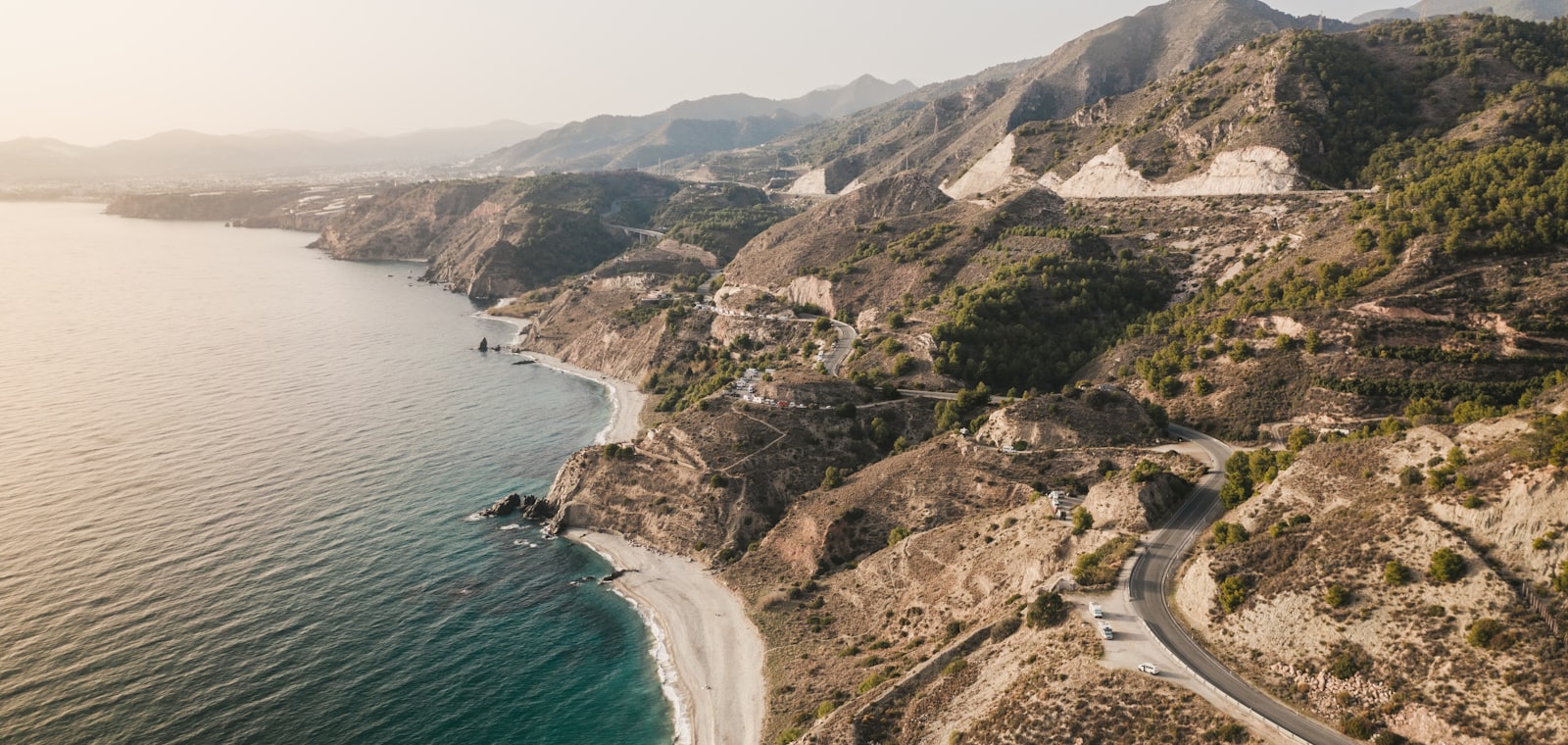
Many travelers know Spain mainly from the beach holiday, where you take a shuttle from the airport to your hotel and stay put. A shame, because Spain is one of those countries where a rental car makes the difference between a holiday and a journey of discovery. Behind the Costas lie white mountain villages, Moorish palaces, endless olive groves and coastal roads that wind around every cliff. With a car you see all of that. Without one you see the swimming pool at your resort.
At the same time, Spain has its quirks, and it pays to know them in advance. Toll roads that alternate with free motorways, low-emission zones in the big cities where foreign cars sometimes have to register beforehand, and parking zones with colour codes that do not mean the same thing everywhere. None of these things is a problem, as long as you know they exist.
This guide walks you through it step by step. We compare the major airports, explain tolls and low-emission zones, suggest two worked-out route ideas with a realistic day-by-day plan, and finish with the mistakes you are best off avoiding. That way you step into your rental car informed, instead of standing in the car park with a question mark over your head.
Why rent a car in Spain?
Because the distances and the way the sights are spread out across Spain make your own transport almost indispensable as soon as you want to go beyond your seaside resort. Public transport between the major cities is excellent, but the most beautiful spots lie precisely in between.
Think of the Costa del Sol and Costa Blanca, where the nicest bays and villages often sit a few kilometres inland or just out of reach of the bus. Or the interior of Andalusia, where you drive from Granada to Cordoba to Seville past landscapes you simply miss by train. A car gives you the freedom to stop wherever you like, to turn off into a mountain village because it looks inviting, and to plan your day without a timetable.
For a pure city break to Madrid or Barcelona, on the other hand, you usually do not need a car, and in the city it is more of a burden because of the low-emission zones and the parking. The golden rule: rent a car if you want to explore the region, leave it behind if you are staying in the city.
Which airport should you choose in Spain?
That depends entirely on your destination, because Spain has a handful of major airports that each open up their own region. Most of them are reachable directly or with a short connection. Below you can see at a glance what each airport is good for.
| Airport | Code | Handy for | Type of destination |
|---|---|---|---|
| Malaga | AGP | Costa del Sol, Andalusia road trip (Granada, Cordoba, Seville, Ronda) | Beach plus culture |
| Alicante | ALC | Costa Blanca, Benidorm, Murcia, Alicante interior | Beach and family |
| Barcelona | BCN | Costa Brava, Catalonia, Pyrenees, Tarragona | City plus coast and mountains |
| Madrid | MAD | Central Spain, Castile, Toledo, Extremadura | Culture and interior |
| Palma de Mallorca | PMI | All of Mallorca (touring the island) | Island holiday |
| Valencia | VLC | Costa de Valencia, Costa del Azahar, city of Valencia | City plus coast |
| Seville | SVQ | Western Andalusia, Cadiz, Huelva, Costa de la Luz | Culture and quiet coast |
A practical tip: for an Andalusia road trip, Malaga and Seville are both good starting points, and it is worth comparing the price of each before you book. Sometimes a flight to one is considerably cheaper, while the rental rate at the other is better value.
OK Mobility at Malaga, Alicante and Palma. In a search on 6 October 2026, Vrooem offered OK Mobility cars at Malaga, Alicante and Palma de Mallorca airports, and at Malaga and Alicante its desk is inside the airport. Our OK Mobility guide covers its rates, cover options and card rules; at Alicante, Vrooem also offers Surprice.
What does renting a car in Spain cost?
It is impossible to give an exact figure, because the price swings sharply with the season, the airport, the type of car and how early you book. What you can keep in mind is where the difference lies.
In the quieter months (pre- and post-season) you generally find very keen base rates for a small car, especially at the major tourist airports where many rental companies compete with one another. At the peak of July and August, and around long weekends, prices rise steeply and a car booked late can cost several times as much. For a sense of the timing, read when is renting a car cheapest.
The trap is that the base rate is rarely your final amount. Add to it the extras that quickly mount up:
| Cost item | What to watch for |
|---|---|
| Base rental rate | Highly seasonal, booking early pays off |
| Buying out the excess | Often the biggest extra, compare beforehand |
| Second driver | Sometimes free, often a daily rate |
| Fuel policy | ”Full-to-full” is usually the best value |
| Tolls and low-emission registration | Depends on your route |
| Child seat or GPS | Per day, often cheaper to bring your own |
Buying out the excess in particular is something people misjudge. So read up beforehand on exactly how it works in our explainer on excess and deposit.
What about tolls on Spanish motorways?
Spain has two kinds of motorway, and only some of them charge a toll. You recognise them by the letters on the signs, and that distinction determines whether you pay along the way or not.
The autopista (AP) is in many cases a toll road, recognisable by the blue signs marked AP and the word “peaje” (toll). The autovia (A) is usually free and often a perfectly good alternative, just a little slower. In recent years, moreover, several former toll roads have become free, so the situation varies by region. Your navigation can usually let you choose between “avoid tolls” or not.
You can pay at a toll booth by debit or credit card and with cash. Many rental cars do not have an electronic toll tag, so reckon on having to stop now and then at a toll gate. Keep a card ready in a compartment within reach, that saves fumbling at the barrier.
Low-emission zones (ZBE): do you need to register anything?
Possibly yes, and this is the point where foreign renters are most often caught out. Spanish cities are rapidly rolling out a zona de bajas emisiones (ZBE), a low-emission zone where not every car is simply allowed in.
In Madrid and Barcelona these zones have been active for a while and are strictly enforced with cameras. The tricky part is that foreign number plates are not automatically in the Spanish system. In some cities a car with a foreign plate has to register online in advance to be allowed into the zone, otherwise you risk a fine even if the car meets the requirements. The rules and the way you register differ by city and change regularly.
The good news for anyone renting a car: this is often the rental company’s problem, not yours. When you pick up the car, ask explicitly whether the vehicle is registered for the low-emission zones of the cities you want to visit, or whether you have to do that yourself. If you are planning a city visit to Madrid or Barcelona, consider parking the car just outside the zone (at a metro station, for example) and doing the last few kilometres by public transport. That is often cheaper and less stressful than driving around in the centre.
Where can you park in Spanish cities?
On the street you recognise paid parking by the colour of the lines, and those colours do not mean exactly the same thing everywhere. The two you come across most often are blue and green.
- Blue zone: paid parking for everyone, usually with a time limit. You take a ticket from the machine and place it visibly behind the windscreen.
- Green zone: usually reserved for, or heavily weighted towards, residents with a permit. As a visitor you may sometimes park briefly and at a higher rate, sometimes not at all.
- White lines: free parking, but rare in city centres and quick to fill up.
- Yellow lines: no parking, do not do it.
In practice, a car park in the city is often the least of your worries. You pay a little more, but you are parked safely, you do not have to keep an eye on a time limit, and you avoid the risk of a fine from a misread colour. For a day trip to a historic centre, that is usually the wisest choice.
Fuel, driving style and culture
Refuelling works the same as at home, with a few accents. Many stations are staffed, but there are also unstaffed, often cheaper stations where you pay at the machine beforehand. Diesel is called “gasoleo” or “diesel”, petrol is “gasolina” (95 or 98). Check at pick-up which fuel your car needs and, if in doubt, choose the “full-to-full” fuel policy, where you bring the car back full.
In terms of driving style, Spain is generally fine. On the motorway people drive briskly but in an orderly way, and the roads are by and large in good condition. In busy cities things are a bit more assertive, and on narrow mountain roads it is mainly a matter of taking it easy and pulling over in good time for oncoming traffic. Bear in mind that the Spanish day starts late and ends late: things are quieter on the road around midday, and the real evening traffic comes later than you are used to.
Route idea 1: Andalusia road trip
This is the classic for anyone who wants to combine culture, history and atmosphere. You start in Malaga and make a loop along three iconic cities. Reckon on four to six days to do it without rushing. The driving times below are guideline times without long stops.
| Day | Route | Guideline driving time | Highlight |
|---|---|---|---|
| 1 | Arrival Malaga, pick up car | short | Settling in, exploring the coastal city |
| 2 | Malaga to Granada | about 1.5 hours | Alhambra (book tickets in advance) |
| 3 | Granada to Cordoba | about 2 to 2.5 hours | Mezquita, old Jewish quarter |
| 4 | Cordoba to Seville | about 1.5 hours | Cathedral, Alcazar, Plaza de Espana |
| 5 | Seville, optional day trip | as you wish | City or a village like Ronda |
| 6 | Back to Malaga | about 2 to 2.5 hours | Optionally take in Ronda along the way |
A few points to keep in mind for this route. Book your Alhambra tickets well in advance, as they are often sold out weeks ahead. Park in a garage in each city and explore the centre on foot. And if you have the time, Ronda, with its famous bridge over the gorge, is a beautiful stop along the way, especially on the way back to Malaga.
Route idea 2: Costa Blanca coastal route
If you prefer to follow the coast and take things more slowly, the Costa Blanca around Alicante is a great fit. This is a relaxed route with plenty of sea, bays and small coastal towns, ideal for a week with the occasional beach stop. Reckon on short driving distances, because everything is relatively close together.
| Day | Route | Guideline driving time | Highlight |
|---|---|---|---|
| 1 | Arrival Alicante | short | City and Santa Barbara castle |
| 2 | Alicante to Calpe | about 1 hour | Penon de Ifach rock, bays |
| 3 | Calpe to Altea and Albir | short | White village, promenade |
| 4 | Day trip inland (Guadalest) | about 45 min | Mountain village with reservoir |
| 5 | Towards Javea and Denia | about 30 to 45 min | Bays, Cabo de la Nao lighthouse |
| 6 | Back towards Alicante | about 1 to 1.5 hours | Beach stop along the way |
The nice thing about this route is that you do not have to drive much, which leaves time to simply settle in somewhere. The coastal road between the towns is, on many stretches, an experience in its own right. Do bear in mind that parking near the popular bays can be tricky in high season, so arrive early.
Insurance, deposit and when to book
The insurance and the deposit together are the most important financial consideration of your rental, more important than the base rate itself. As standard there is usually insurance included with a hefty excess, the amount you cover yourself in the event of damage, and the rental company blocks that amount as a deposit on your credit card.
You can buy out that excess, and there is a big difference between the more expensive buy-out at the desk and an external policy taken out in advance. Which route is smartest for you depends on your situation. We explain it fully in excess and deposit. Either way, make sure you have a genuine credit card in the name of the main driver with enough room for the deposit, because a debit card is often refused.
In terms of timing, the same applies to Spain as to most sun destinations: the busier the season, the earlier you should book. For July and August you are best off booking months ahead. In the pre- and post-season there is more room and you often find better deals. You can read more about this in our 12 tips and in when is renting a car cheapest.
Common mistakes when renting a car in Spain
A short list of pitfalls that keep coming up, so you can avoid them.
- Looking only at the base rate. The cheapest advert is rarely the cheapest final amount. Compare with the excess and extras included.
- Not bringing a credit card. Without a credit card in the driver’s name, the deposit cannot be blocked and you are left empty-handed at the desk.
- Ignoring the low-emission zone. In Madrid and Barcelona you can pick up a fine, even with a rental car. Ask about it at pick-up.
- Not inspecting the car. At pick-up, take photos and a short video of existing damage, all around and in detail. That is your evidence at return.
- Returning with an almost empty tank. With “full-to-full” you otherwise pay a steep guesstimate rate for the rental company to refuel.
- Booking too late in high season. In July and August the keen rates dry up fast.
Frequently asked questions
Do I need an international driving licence to drive in Spain?
It depends on where you are from. Within the EU you drive in Spain with your ordinary national (European) licence without any problem, and no international permit is needed. Travelers from outside the EU usually need an International Driving Permit alongside their national licence, and sometimes a certified translation, so check the requirement for your country before you travel. Do always bring your valid driving licence and ID or passport.
What is the minimum age to rent a car in Spain?
Usually 21, and often you must have held the licence for a certain number of years. Young drivers (typically under 25) pay a young-driver surcharge per day at many rental companies. Check this when you book, because the exact rules differ by rental company.
Can I drive into Madrid and Barcelona with a foreign-registered or rental car?
Sometimes you have to register in advance. Both cities have low-emission zones with camera enforcement, and foreign number plates are not automatically in the system. With a rental car, ask whether it is registered, or park outside the zone and continue by public transport.
Are tolls on Spanish motorways compulsory?
No, you can often avoid them. The toll autopistas (AP) usually have a free autovia (A) as an alternative, which is a little slower. Your navigation can avoid tolls. You can pay at the toll booth by card or cash.
Which airport is the best starting point for Andalusia?
Malaga or Seville, depending on your route and the price. Malaga is ideal if you want to take in the Costa del Sol, Seville if you want to start in the west. Compare the combination of flight and rental price for both before you choose.
Do I have to bring the car back full?
With the “full-to-full” policy, yes, and that is usually the best value. You get the car full and bring it back full. Fill up just before you hand it in and keep the fuel receipt. With other policies you often pay a less favourable rate for the fuel.
What do I do in the event of damage or a breakdown along the way?
Call the rental company’s emergency number listed in the contract, and take photos of the situation. In the event of a collision, fill in a European accident statement form. Do not arrange any damage settlement outside the rental company, and do not have any repairs carried out without permission.
Do I need a rental car for a city break to Barcelona or Madrid?
No, it is more of a burden. Both cities have excellent public transport, expensive parking and strict low-emission zones. Only rent a car if you want to head out into the region from the city, and then ideally pick it up on the day you leave the city.
Ready to compare?
Compare the prices of international rental companies in a few taps and book with peace of mind.
See the offer on Vrooem