Renting a car in Portugal: Lisbon, Porto and the Algarve
Some buttons on this page link to vrooem.com, where you compare and book the offer of international rental companies. Our guides are written independently.
Portugal looks small on the map, but it is the kind of country you only really get to know from behind the wheel. The big cities have their trains and trams, but the moments you tell stories about later are somewhere else entirely: an empty coastal road towards Sagres where the Atlantic pounds the cliffs, a vineyard high above the Douro, a white village in the Alentejo where you are the only tourist. No train takes you to those places. A rental car does.
At the same time, Portugal is the country where travellers most often run into a nasty surprise, and almost always for the same reason: the tolls. Portugal has a network of electronic toll roads with no toll booths, where cameras read your number plate and the bill arrives later. Anyone unaware of this drives blissfully along the motorways and receives a charge from the rental company weeks later, including service fees. It is no disaster once you understand how it works, but it is the first thing to sort out.
In this guide we cover everything from the practical choices (which airport, which season, which insurance) to the two finest routes you can drive from a rental car. And we pay plenty of attention to that toll pitfall, because that is where most of the confusion lies.
Why rent a car in Portugal?
Because the most beautiful parts of Portugal are poorly served or unreachable by public transport. A car gives you access to the Algarve coast, the rolling Alentejo and the Douro valley, places where buses are rare and trains do not run.
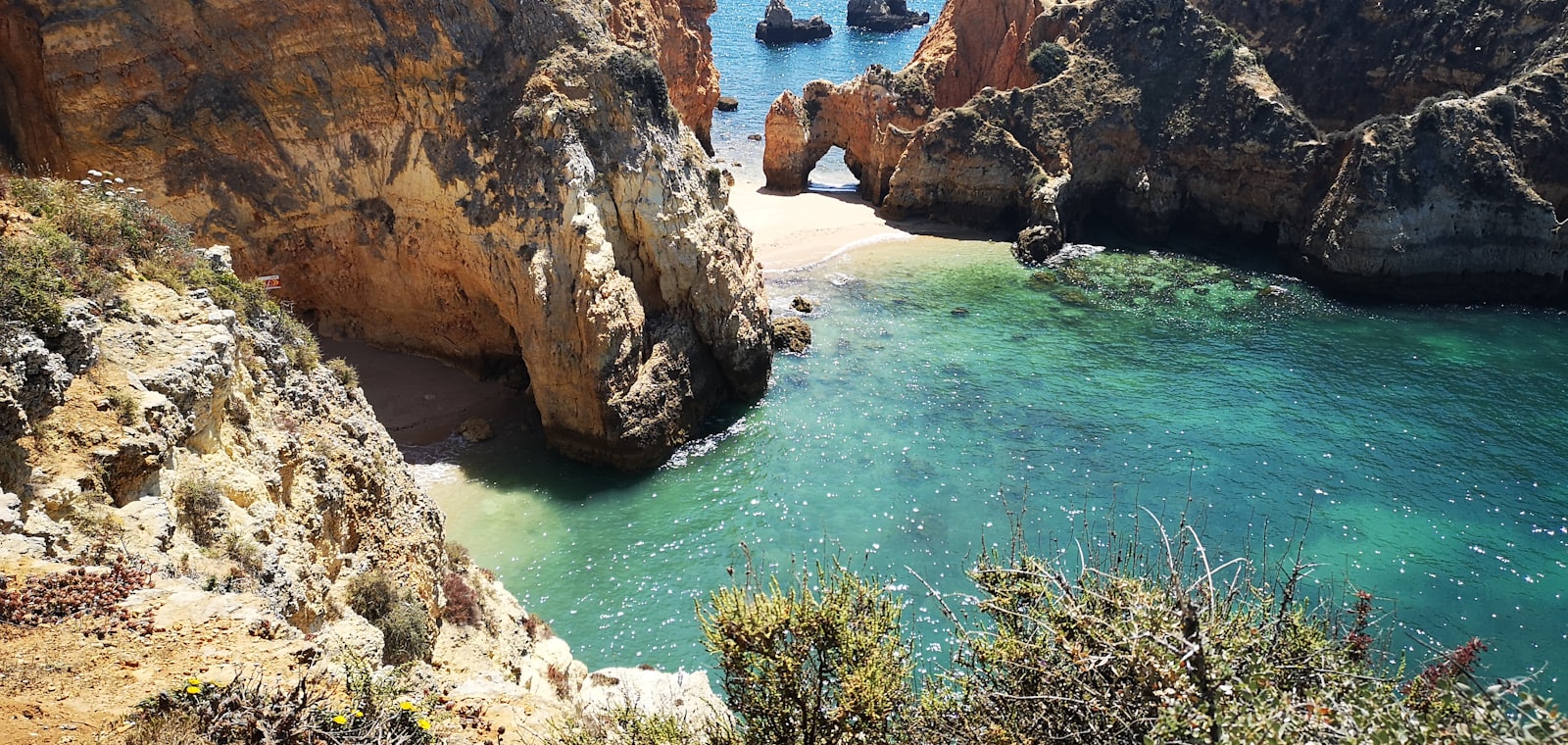
The Algarve in the south is the classic choice. The coastline between Faro and Sagres is full of hidden coves, fishing villages and viewpoints that you can only explore at your own pace by car. Buses do run, but they mainly connect the larger towns and skip the loveliest corners.
The Alentejo, the vast interior between Lisbon and the Algarve, may be the strongest argument of all. Cork oaks, rolling fields, white villages and towns like Evora and Monsaraz. Here a car is almost a requirement, because public transport is sparse.
The Douro valley east of Porto is the third major draw. The terraced vineyards along the river are among the most beautiful landscapes in Europe. A scenic train runs along the Douro, but to reach the quintas (wine estates) and viewpoints you will want a car.
Where are you better off without a car?
In the historic centres of Lisbon and Porto. There the streets are narrow and steep, trams run through them, parking is scarce and expensive, and a car will mostly leave you stuck rather than moving.
Lisbon is built on hills, with narrow, cobbled streets in neighbourhoods like Alfama where even local drivers manoeuvre with care. The famous tram 28 shares those streets with you. Parking spots are scarce and traffic in the centre is heavy. The same goes for old Porto with its steep alleys down to the banks of the Douro.
The practical solution: if you combine city and countryside, do the city first on foot and by public transport, and only pick up the car when you head out of town. Many travellers collect the car at the airport at the end of their city stay, or at a station just outside the centre. That way you avoid paying for days when the car is only sitting in an expensive parking spot.
Which airport should you choose?
That depends on where you want to go. Portugal has four airports that matter to most travellers, each with its own surrounding region. Faro is the gateway to the Algarve, Lisbon and Porto serve the north and centre, and Funchal is on Madeira.
| Airport | Code | Region / starting point for | Suits |
|---|---|---|---|
| Lisbon | LIS | Centre, Sintra, Cascais, Alentejo | City plus a southward road trip |
| Porto | OPO | North, Douro valley, Minho | Wine, river, greener Portugal |
| Faro | FAO | Algarve coast | Beach and coastal holiday |
| Funchal (Madeira) | FNC | Island of Madeira | Mountains, levadas, island tour |
Faro is the logical choice for most beachgoers: you are on the first coastal road within half an hour. If you want to combine city and countryside, Lisbon is versatile: do the city first without a car, then rent one and drive towards Sintra, Cascais or the Alentejo. Porto is ideal if the Douro valley is your main goal. Madeira is a different story: an island with mountainous, winding roads where driving calls for a particular style and some experience.
Rental companies at Faro and Lisbon. In a search on 6 October 2026, Vrooem offered Green Motion, U-Save, Surprice and Record Go at both Faro and Lisbon airports. Our brand guides explain how each one handles the shuttle, the deposit card and the fuel rule: Record Go in Portugal, Green Motion, Surprice and Green Motion vs U-Save.
How do tolls work in Portugal, and why are they a pitfall?
Portugal has two kinds of toll roads. On some you still stop at a toll booth and pay on the spot. On others, the fully electronic motorways, there is no barrier: cameras read your number plate and the toll is registered afterwards. It is precisely this second kind that catches out foreign renters.
Some of these electronic toll roads are the former SCUT motorways, often marked with an “A” plus a number and with signs referring to electronic payment (such as “Electronic toll only” or references to Via Verde). There is no way to pay on the spot. You drive along, a camera records you, and the bill has to come later.
For rental cars, the rental companies usually solve this with an electronic toll device in the car, similar to Portugal’s Via Verde system. The tolls you incur are then registered through that device, and the rental company charges them to you afterwards. The problem is not the toll itself (those amounts are usually modest), but the service fees the rental company adds on top. Some companies charge a fixed amount for each day you have the car, or for each day you actually use a toll road, plus sometimes an activation fee. Over a longer rental period that service fee can add up considerably, sometimes to more than the toll itself.
So here is what you should do at pick-up:
- Ask explicitly how tolls are handled by this company. Is there a toll device in the car? Is it active automatically, or do you need to switch it on or activate it?
- Ask what the service fee is: per day, per month, one-off? And does it apply to every rental day or only the days on which you actually use a toll road?
- Ask whether, and how, you can switch off the device if you plan to avoid the toll roads.
Paying individually as a private driver is cumbersome. Portugal has payment points and payment options for occasional users, but that system is fiddly, and if the rental car already has a device, the bill goes through the rental company anyway. In practice it is almost always easier to understand in advance how your rental company handles it than to try to arrange it yourself.
| Type of toll road | How you pay | Watch out for |
|---|---|---|
| Classic toll road with toll booth | On the spot (card or cash), or via a device in the lane for subscribers | Follow the correct lane; the Via Verde lane is for device holders only |
| Fully electronic motorway (incl. ex-SCUT) | No barrier; camera reads the plate, billed afterwards | The rental car handles this via a toll device plus a service fee; ask about it at pick-up |
What should you know about parking, fuel and the roads themselves?
In short: paid parking is marked by blue zones with ticket machines, you fill up just as you do at home, and the roads range from smooth motorways to very narrow village lanes. Adapt your pace to the road and you will get everywhere.
Parking. In cities and tourist towns you will find blue zones: paid street parking where you buy a ticket in advance at the machine and place it behind your windscreen. In busy coastal spots in high season, parking is scarce; arrive early or choose a car park on the edge of town. Larger cities have paid parking garages, which in centres like Lisbon and Porto are often the least stressful option.
Fuel. Petrol stations work the way you are used to, with self-service and card payment. At pick-up, note the arrangement around the tank: the most common and fairest system is “full to full”. Where possible, avoid arrangements where you pay for a full tank in advance and return it empty, because you usually end up paying too much.
Driving style and roads. On the main roads the going is smooth. In villages and in the countryside, streets can become very narrow, sometimes with room for just one car, and oncoming traffic and parked cars may force you to reverse. Take your time in old village centres, and on mountainous stretches (certainly on Madeira) the bends are sharp and the gradients steep. A smaller car is a blessing there, both for manoeuvring and for parking.
Which route suits you? Two worked-out ideas
Below are two routes that show why you rent a car in Portugal in the first place. One revolves around the coast, the other around the city and the hinterland. The times are generous guidelines, not a schedule: adjust them to your own pace and the season.
Route 1: the Algarve coast (base: Faro). A relaxed coastal route from east to west, ideal if you want to combine beaches, cliffs and fishing villages.
| Time of day | Destination | What you do |
|---|---|---|
| Morning, day 1 | Faro and Ria Formosa | Faro’s old town, then the lagoon and islets of the Ria Formosa nature park |
| Afternoon, day 1 | Towards Lagos | Drive west at a relaxed pace, stopping at a cove or beach along the way |
| Morning, day 2 | Lagos | Ponta da Piedade with its rock formations, the old centre, a boat trip past the caves |
| Afternoon, day 2 | Sagres | The southwesternmost tip, a cape with a fort and lighthouse, vast ocean skies |
| Spare | West coast | If you have time, drive further north along the wilder, empty west coast |
Expect relaxed days with short driving distances. Distances in the Algarve are small, so the gain lies in stopping often, not in covering ground quickly.
Route 2: Lisbon, Sintra and Cascais, or the Douro from Porto. Here you choose between two variants, depending on your airport.
| Variant | Base | Highlights |
|---|---|---|
| Sintra and Cascais | Lisbon (LIS) | City first on foot, then by car: the palaces and forests of Sintra, the coastal road past Cabo da Roca to fashionable Cascais |
| Douro valley | Porto (OPO) | Porto on foot, then by car along the Douro: wine terraces, quintas, viewpoints towards Pinhao |
For the Lisbon variant: explore the city without a car and only rent one when you head to Sintra. Sintra itself is busy and parking is limited, so go early and park on the edge. The coastal road from Cabo da Roca (the westernmost point of mainland Europe) to Cascais is one of the finest short drives in the country.
For the Douro variant: do Porto first on foot and by tram, and use the car to drive up the river. The roads along the Douro are winding and slow, but that is exactly the point. Allow plenty of time and be careful after a wine tasting; if you taste, it is better to let someone else drive or to plan an overnight stay.
What does it cost, and which season is best?
Honest answer: it depends heavily on season, region and how early you book. The Algarve in July and August is the most expensive and crowded; spring and autumn give the best balance between price, weather and quiet.
High season (the summer holidays) drives up both rental prices and crowds on the coast, and in the Algarve cars can sometimes be scarce if you book late. Spring (April to June) and early autumn (September, October) are the most beautiful for many travellers: pleasant weather, lower prices and fewer people. For the Douro, the harvest period in autumn has a special atmosphere. If you want to know how to pick the best moment, read when is renting a car cheapest.
Besides the daily rate, the real costs mainly add up through extras: insurance, the young-driver surcharge, the airport surcharge, a second driver, and in Portugal also the tolls with the service fee. A small, economical car is almost always the smartest choice for the narrow village roads and for parking, and at the same time the cheapest. Work out the total price in advance rather than looking only at the daily rate; more on this in our 12 tips for renting a car abroad.
What about insurance and the deposit?
At pick-up, the rental company blocks a deposit on your credit card and there is almost always an excess: the amount that remains your responsibility in case of damage or theft. You can buy off that excess, but the way you do so strongly determines what you pay and how well you are covered.
The standard insurance in the base rate usually leaves a substantial excess, which is blocked as a deposit on your credit card. You can reduce it with the rental company’s own cover or package, or with a separate excess insurance policy; check what each one covers, because some rental companies still block the full deposit when you rely on your own policy. Before you leave, read up on exactly how this works in our explanation of excess and deposit on a rental car, so that you can make that choice calmly at home.
Also watch out for the typical exclusions: damage to tyres, windows, the underbody and the roof often falls outside the standard cover. Always take photos of the car all the way around at pick-up, including existing scratches and dents, and check that they are noted on the damage form. Do the same when you return it. The approach is not fundamentally different from neighbouring Spain; feel free to compare with our guide on renting a car in Spain.
Which mistakes do people make most often?
Most misunderstandings can be avoided with a little preparation. These are the classics:
- Ignoring the tolls. By far the biggest one. Not asking how tolls are handled, and then getting a shock weeks later from a bill with service fees.
- Renting a car for the city days. Paying for days when a car only sits in an expensive parking spot in Lisbon or Porto.
- Renting too big. A large vehicle is awkward on narrow village roads and when parking, and more expensive on fuel. Small is often smarter.
- Taking the counter buy-out without comparing. Accepting an expensive excess buy-out under time pressure instead of arranging something cheaper in advance.
- Taking no photos. Without proof of the initial condition, you are in a weak position if there is a dispute over damage.
- The fuel trap. Paying for a full tank in advance and returning it empty, so you pay for air.
- Booking too late in high season. In the Algarve in summer, cars can become scarce and expensive.
Frequently asked questions
Do I have to pay tolls in Portugal with a rental car?
Usually yes, as soon as you drive on a toll road. Some of the Portuguese motorways are fully electronic with no toll booth, and rental cars often have a toll device for this. The rental company charges the tolls you incur afterwards, generally with a service fee added on top. Ask at pick-up exactly how it is arranged.
What is that toll service fee and can I avoid it?
It is an amount the rental company charges on top of the actual toll for the use of the toll device, often per day or per month. You can only avoid it by not using electronic toll roads, and even then you need to check whether the service fee is charged anyway. Ask about this explicitly at pick-up.
Which airport should I choose for the Algarve?
Faro (FAO). That is the Algarve’s airport; you are on the first coastal roads within half an hour. For the centre, Sintra and the Alentejo choose Lisbon (LIS), and for the Douro valley Porto (OPO) is the logical starting point.
Do I need a car in Lisbon or Porto?
In the cities themselves, no, quite the opposite. The historic centres are narrow, steep and busy, with trams and little parking space. Explore the city on foot and by public transport, and only pick up the car when you head to the coast or the interior.
Is driving on Madeira difficult?
It takes some experience. Madeira is mountainous, with narrow, winding roads and steep gradients. It is manageable if you drive calmly and take a smaller, nimble car, but it is more demanding than driving on the mainland.
When is it cheapest and quietest to rent a car in Portugal?
In the shoulder seasons, so roughly April to June and September to October. Prices are lower and it is quieter than in the summer holidays, while the weather in most regions is still pleasant. Do book in good time, though, because booking early often gets you the best rates.
What is best to cover in terms of insurance?
Make sure your excess is well covered, because that is the amount that would otherwise remain your responsibility in case of damage. A cover taken out in advance is often cheaper than the buy-out at the counter. Also watch out for the typical exclusions such as tyres, windows and the underbody.
Should I take photos of the rental car?
Yes, always. At pick-up, take photos all the way around the car, including existing damage, and check that they are noted on the form. Do the same when you return it. That way you are in a strong position if a dispute later arises over damage or the final bill.
Ready to compare?
Compare the prices of international rental companies in a few taps and book with peace of mind.
See the offer on Vrooem