Renting a car in Turkey: the turquoise coast and the toll system (HGS)
Some buttons on this page link to vrooem.com, where you compare and book the offer of international rental companies. Our guides are written independently.
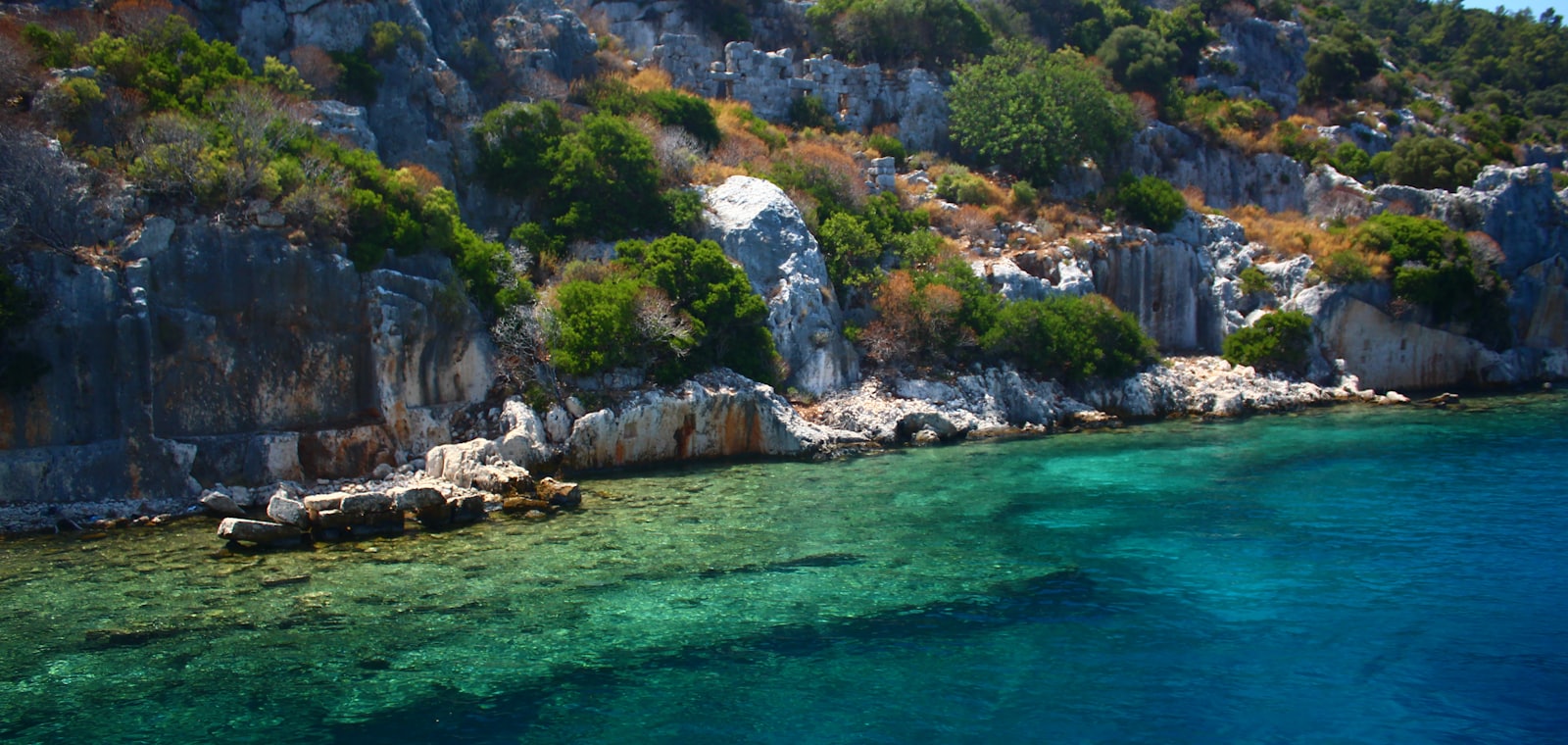
Renting a car in Turkey feels like two trips in one. Along the south coast the road winds past the Lycian shore, with pine trees that grow right down to the turquoise water, ancient tombs cut into the cliffs, and little bays you can only truly reach with your own car. A day later you can drive inland to Cappadocia, where the landscape turns into a moonlike world of tuff cones, underground cities and hot-air balloons at sunrise. That contrast, sea and steppe, antiquity and folklore, is exactly why so many travelers want to discover Turkey by car.
The Aegean coast adds a third layer. From Izmir you can drive in an hour to Ephesus, one of the best-preserved ancient cities in the world, and on to the limestone terraces of Pamukkale. Bodrum and the peninsula around it beckon with white villages and marinas. These are places that are cumbersome to reach by public transport, but with a rental car you can string them together into one smooth road trip.
At the same time Turkey is big, very big, and not everywhere is equally relaxing to drive. This guide helps you decide where a car gives you freedom and where it mostly causes stress, and it explains how the things that surprise travelers most often actually work: the electronic toll with no toll booths, the documents you need to carry, and the practical side of fuel, parking and police checks.
Do you really need a car in Turkey?
For the coast and the interior: yes, a car opens up places that would otherwise be almost unreachable. For central Istanbul: no, leave the car parked there.
Turkey’s most beautiful spots are scattered. The Lycian coast is a string of bays, villages and ruins that lie kilometres apart, often at the end of a dead-end road that no bus reaches. Cappadocia consists of a handful of villages (Göreme, Uçhisar, Avanos) with valleys between them that you explore best at your own pace. In areas like these a rental car is worth its weight in gold: you set off early to beat the crowds, you stop wherever it is beautiful, and you do not have to wait for a dolmuş (shared minibus) that may or may not show up.
In big cities the logic flips. The historic centre of Istanbul is a busy, densely built tangle where parking is expensive and scarce, the traffic chaotic and assertive, and where trams, the metro, ferries and taxis get you there faster and cheaper. Many travellers therefore opt for a combination: do the city section without a car, and only pick up the car when they head out of town. That saves parking stress, in-city toll costs and a lot of grey hairs.
At which airport should you rent your car?
That depends on your route: for the south coast you start in Antalya or Dalaman, for the Aegean route in Izmir or Bodrum, and Istanbul is mainly a city destination. Choose the airport closest to your first real destination, so you do not have to drive for hours before your holiday begins.
| Airport | Code | Region | Good for |
|---|---|---|---|
| Istanbul | IST / SAW | Northwest, Marmara | The city itself (a car is more hindrance than help in the centre) |
| Antalya | AYT | South coast | Lycian coast: Olympos, Kas, Kalkan, Fethiye |
| Izmir | ADB | Aegean coast | Ephesus, Sirince, Pamukkale, Cesme |
| Dalaman | DLM | Southwest coast | Fethiye, Ölüdeniz, Dalyan, Kas |
| Bodrum | BJV | Aegean coast (south) | Bodrum peninsula, Gümüşlük, day trips |
Istanbul has two airports: the large Istanbul Airport (IST) on the European side and Sabiha Gökçen (SAW) on the Asian side. For the coastal routes that distinction does not matter, because you fly on to the south or west anyway. For the Lycian coast both Antalya and Dalaman make sense: Antalya sits at the eastern end of that coast, Dalaman at the western end, so choose based on where your trip starts and ends.
How does the electronic toll work in Turkey?
Turkish motorways (otoyol) and the big bridges over the Bosphorus use a fully electronic toll system (HGS) with no toll booths: there is nowhere to pay with cash or card at a barrier. You simply drive through and the system reads a sticker or device on your windscreen.
For anyone driving a rental car, this is the most important thing to understand in advance. The car will normally already have an HGS device or sticker. The toll you run up along the way is settled afterwards by the rental company, usually via your credit card or the deposit, and sometimes with an administration or service fee on top of the actual toll amount. This is very similar to the pitfall many travelers know from Portugal, where the electronic toll is also settled afterwards through the rental company. The danger is not in large amounts, but in the surprise and the extra cost you had not budgeted for.
So at pickup, ask explicitly how the toll is arranged. Does the car have a working HGS device? How and when is the toll settled? Does the rental company charge a fixed service fee per toll passage, per day, or only the actual amount? Preferably get the answer in writing, and keep your contract.
On many coastal routes and in Cappadocia you will, by the way, drive largely on ordinary roads with no toll. The toll mainly comes into play when you cover long motorway stretches or use the big bridges in and around Istanbul.
What is it like to drive in Turkey?
Calmer than its reputation in the countryside, more intense than you are used to in the cities. People drive on the right, the roads between the tourist spots are generally good, but in and around big cities the traffic is busy and assertive.
In cities like Istanbul, Izmir and Antalya the driving is forceful: lanes are more a suggestion than a rule, people merge briskly and honk freely, and scooters and motorbikes pop up everywhere, including between the queues of traffic. Keep your distance, be predictable and do not let yourself be rushed. Outside the cities it is usually manageable, although on narrower coastal and mountain roads you will meet slower, twistier traffic.
Expect speed checks and police checks, which are fairly frequent, including on holiday routes. At a check it is usually a routine document check. So keep your driving licence, the rental contract and your passport within reach at all times, and stay calm and polite. The mountain roads to, for example, the interior or certain coastal villages are perfectly drivable but require attention: sharp bends, sometimes little crash barrier, and in high season other tourist traffic.
Which documents do you need?
In practice your national driving licence is usually enough to rent and drive a car in Turkey, together with your passport. An international driving permit (IDP) is not a replacement but a safe addition that prevents misunderstandings with the rental company or at a check.
A driving licence in Latin script is accepted by most rental companies. Even so, some rental companies or officers ask for an international driving permit, an official translation of your national licence. Because an IDP is cheap and quick to apply for, it is worth taking one along, especially if you are going to drive a lot or head into the interior. Also bring the credit card in the name of the main driver, as that is almost always required for the deposit.
A full overview of what you take with you abroad as standard, and the details around the international driving permit, can be found in our guide on which documents you need.
| Document | Needed? | Note |
|---|---|---|
| National driving licence | Always | Main driver, valid and in their name |
| International driving permit (IDP) | Recommended | Safe addition, not a replacement |
| Passport | Always | Identity at pickup and checks |
| Main driver’s credit card | Almost always | For deposit and toll settlement |
| Rental contract | Always in the car | At police checks |
Fuel, parking and navigation
Refuelling is easy: petrol stations are plentiful along main roads and in cities, and you are often served by a pump attendant. Parking is usually straightforward in villages and smaller towns, but limited and paid in city centres and tourist hotspots.
Fuel is not especially cheap in Turkey, so budget a decent amount for it. Bear in mind that prices can fluctuate and that remote mountain villages do not always have a pump: top up in good time. At many stations you pay in cash or by card; always check that the right fuel is being put in (petrol versus diesel) and ask the pump attendant if needed.
For parking the rule is: avoid parking in messy spots in city centres and instead use a guarded car park (otopark) or your hotel’s parking. In coastal villages and near ruins there is usually a paid parking spot close by. For navigation the common smartphone apps work fine; download offline maps for the interior and the mountains, where mobile coverage can drop out.
Route idea 1: the Lycian coast
This classic starts in Antalya or Dalaman and follows the southwest coast past ancient ruins and turquoise bays. Allow roughly a week to do it at a relaxed pace, with short driving distances between stops.
| Day | Leg | Highlights |
|---|---|---|
| 1 | Arrival in Antalya | Old town (Kaleiçi), settling in |
| 2 | Antalya to Olympos/Çıralı | Ancient ruins, beach, Chimaera flames |
| 3 | Olympos to Kaş | Mountain coast road, diving village Kaş |
| 4 | Kaş and surroundings | Kalkan, little bays, optional boat trip |
| 5 | Kaş to Fethiye/Ölüdeniz | Blue lagoon, Lycian tombs |
| 6 | Ölüdeniz and surroundings | Beach, paragliding, Saklıkent gorge |
| 7 | Back to Dalaman/Antalya | Return car, departure |
The driving distances are relatively short, but the coast road is winding and slow, so do not underestimate the travel time: a sixty-kilometre leg can easily take more than an hour. Plan the car return with a margin before your flight.
Route idea 2: Aegean coast or Cappadocia
Option A follows the Aegean coast from Izmir past Ephesus, Pamukkale and Bodrum. Option B is a loop through Cappadocia, deeper inland. Both are good for a week, but very different in atmosphere.
For the Aegean route you start in Izmir (ADB) and drive a short leg to Selçuk for Ephesus and the little village of Şirince. After that you head inland to the white limestone terraces of Pamukkale and ancient Hierapolis. From there you drop down towards the coast to Bodrum, with room along the way for bays and marinas. It is a mix of culture and coast with manageable driving distances.
Cappadocia is another story. You usually fly to a domestic airport (for example via Kayseri or Nevşehir) and rent a car there to explore the villages Göreme, Uçhisar and Avanos and the surrounding valleys. The distances within Cappadocia are small, so the car mainly serves to roam freely between rock churches, underground cities and viewpoints. If you want to combine Cappadocia with the coast, that is a long drive (many hours of motorway with toll); many travellers therefore take a domestic flight between coast and interior and rent separately at each destination.
Insurance, deposit, season and costs
A rental car in Turkey almost always comes with insurance and a deposit, but the standard excess can be high. Understand in advance what is and is not covered, because that determines your real risk more than the daily rate does.
As everywhere, watch the combination of excess, deposit and exclusions. Damage to tyres, windows, the underbody and mirrors often falls outside the basic cover, and those are exactly the things you pick up fastest on narrow coastal lanes and unpaved tracks. The deposit is held on the main driver’s credit card. How you can buy off or cover the excess, and what to watch for with the deposit, we explain in our guide on excess and deposit.
As for season: the high season on the coast runs roughly from late spring to early autumn, with the highest prices and busiest roads in July and August. Late spring and early autumn give more pleasant weather, quieter roads and often better rates. We deliberately do not quote exact prices, because rental rates, fuel and toll costs vary widely by season, rental company and exchange rate. Alongside the daily rate, be sure to also budget for fuel, any toll, parking and possible service fees.
For more general strategy on keeping costs and hassle low, our list of 12 tips is a useful addition. And if you are torn between destinations in the eastern Mediterranean, feel free to also compare with renting a car in Greece.
Common mistakes
The biggest misstep is picking up the car too early for a city visit. Anyone who lands in Istanbul with a rental car and grabs it right away pays parking and toll costs for a vehicle that is mostly in the way in the city. Only pick it up when you head out of town.
A second classic is ignoring the electronic toll. Travellers assume that, as at home, they can pay somewhere in cash, and are later startled by the charge with a service fee. Ask about it at pickup and keep your contract.
Beyond that, many people underestimate the travel time on coastal and mountain roads, which leads them to cram their itinerary too full. Other common mistakes: forgetting to photograph the car all around at pickup for the damage check, not downloading offline maps for the interior, not checking the air conditioning before a summer trip inland, and not reading the insurance exclusions (tyres, windows, underbody).
Frequently asked questions
Is my national driving licence enough to drive in Turkey?
Usually yes, together with your passport. An international driving permit (IDP) is a safe addition that prevents misunderstandings with the rental company or at a check, especially if you drive a lot. See the details in the documents guide.
Do I have to pay the toll myself in Turkey?
Not at the roadside, because the system (HGS) is fully electronic and has no toll booths. Rental cars usually have a device, and the rental company charges the toll afterwards, sometimes with a service fee. Ask at pickup exactly how this is arranged.
Do I need a car in Istanbul?
Not for the centre: the traffic is busy and parking expensive and scarce, while trams, the metro, ferries and taxis get you there faster. A car is mainly useful for the coast and the interior, not for the city itself.
When is the best time to drive in Turkey?
Late spring and early autumn are often the most pleasant: less heat in the interior, quieter roads and generally more favourable rates than at the peak in July and August. In high summer the coast is busy and the interior very hot.
How busy and safe is the traffic?
In the countryside and on the tourist routes it is manageable, while in the big cities the driving is busy and assertive with lots of scooters. Keep your distance, stay predictable and expect regular speed and police checks where you must have your documents ready.
Can I combine Cappadocia and the coast in one drive?
You can, but it is a long drive of many hours of motorway with toll. Many travellers prefer to take a domestic flight between coast and interior and rent separately at each destination, which saves time and driving stress.
What should I check when picking up the car?
Check the HGS device and the toll arrangements, photograph the car all around for the damage check, test the air conditioning (especially before a summer trip inland), and read the insurance exclusions such as tyres, windows and underbody. Keep the rental contract in the car.
How much does it cost to rent a car in Turkey?
That varies widely by season, rental company and exchange rate, so exact figures are not meaningful to quote. Alongside the daily rate, also budget for fuel, possible toll with a service fee, parking and the excess. Read more about cover in the guide on excess and deposit.
Ready to compare?
Compare the prices of international rental companies in a few taps and book with peace of mind.
See the offer on Vrooem